
How Poplar works
Write one Poplar, get five back from strangers. Anonymous or signed per entry. No likes, no algorithm. Here is how the whole diary works, plainly.


Key takeaways
- One Poplar out, five back: you can't lurk and you can't broadcast. The room stays full of people who are actually writing.
- Anonymity is per-entry, not per-account — same diary, signed or unsigned, your call every time you post.
- Root = private save (warmer than a like, visible only to the author). Echo = reply as your own entry, branching into a thread. Friends = mutual-only, no follower count shown to anyone.
- Odyssey is the collaborative mode: multi-author stories, 300-word chapters, turn-locked once written.
- What Poplar doesn't have is as important as what it does: no algorithmic feed, no public like count, no follower count, no paywall on the core mechanic.
A diary someone else actually reads.
Most apps that promise a diary give you a clean white page, a streak counter, and silence. Most apps that promise community give you an audience, an algorithm, and an undertow. Poplar is a diary someone else actually reads, and a small social space where the only way in is to write something honest first. This is how the whole thing works, plainly.
Poplar is an anonymous social diary. You write one entry, called a Poplar, and five entries from other writers come back to you. You can post anonymously or under your username, picked per entry.
There's no public like count, no follower number, no feed ranked by what makes you angriest. It's small and indie. One developer, a few thousand quiet writers.
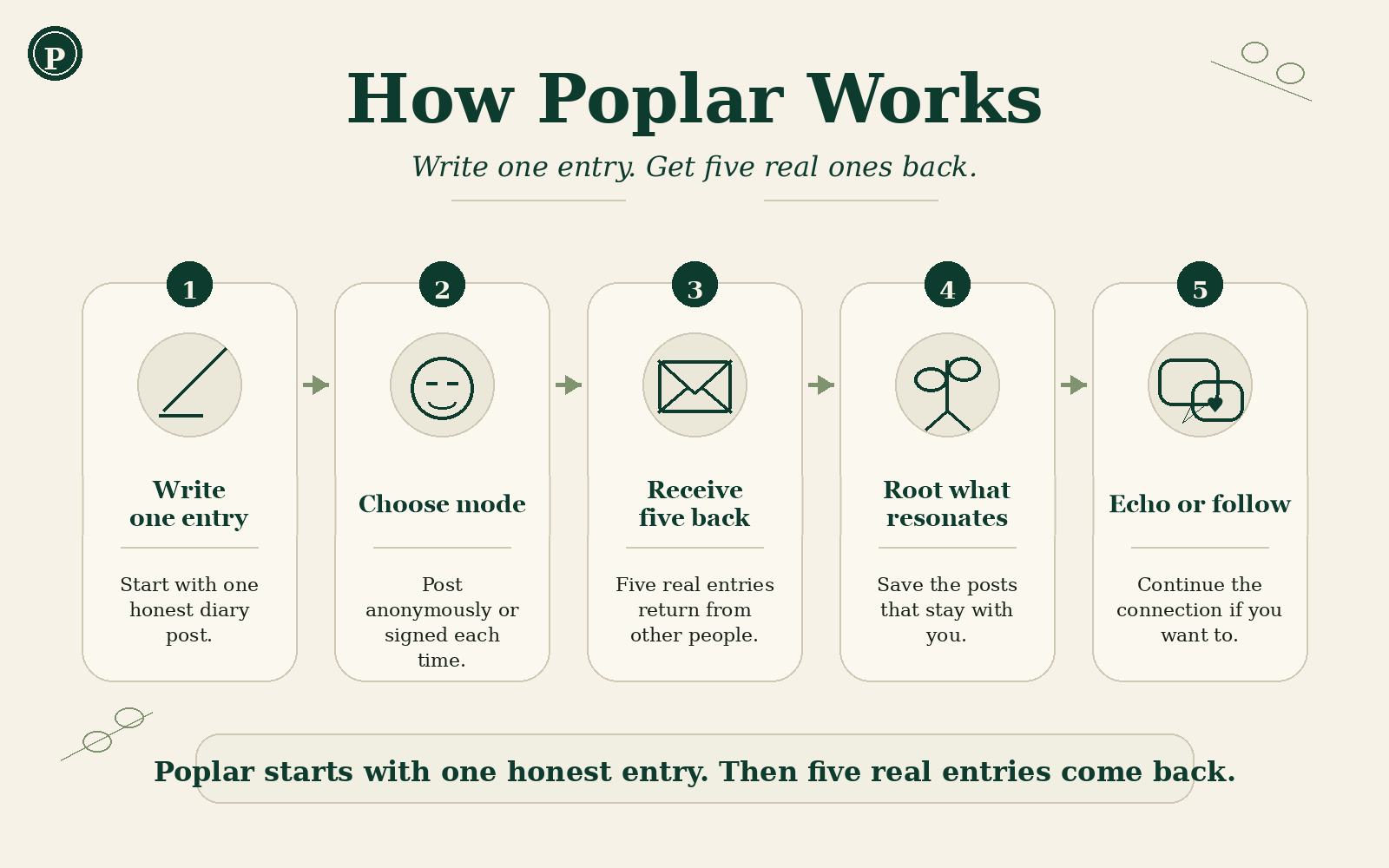
The one-in-five-back trade.
The core of Poplar is a swap. Write one Poplar, you get five from strangers in return. That's it. That's the gravity of the whole thing.
A diary nobody reads turns into a chore. A feed you can read without contributing turns into a doomscroll.
That's the one reason the mechanic exists. The trade keeps both sides honest. You can't lurk. You can't broadcast either, since the cap is three Poplars per day per writer. The room stays full of people who are actually writing.
The trade also leans on one of the older findings in relationship science. In Nancy Collins and Lynn Miller's meta-analysis of the disclosure literature, people who disclose intimately are liked more than people who hold back, and we come to like the people we've disclosed to. Poplar builds that loop into the plumbing.
The five entries that come back aren't an algorithmic recommendation. They're random per session, swiped through one at a time on a card stack. Sometimes the first one lands. Sometimes the third does. Sometimes none do, and that's fine. Tomorrow you'll see a different five.
What a Poplar looks like.
A Poplar is an entry. It can be three sentences or three hundred. You write it in a soft text field, and before you submit, you make a small choice that most journaling apps don't give you: anonymous, or signed. Per entry. Not per account.
If you post anonymously, your entry shows up to readers as "Anonymous" with no link back to your profile. If you post signed, it goes out under your username, and a reader can tap through to your bio. Most writers mix the two, depending on what they're saying that day.
Why unsigned isn't hiding.
The choice does real work. In Adam Joinson's studies of online conversation, visually anonymous participants disclosed significantly more about themselves than people who could be seen.
John Bargh's lab experiments in 2002 found something stranger: people paired with a stranger online, rather than face-to-face, were better able to express their true-self qualities to their partner. Unsigned, for a lot of writers, is the more honest setting.
You can add:
Doodle
Sketch something in the entry itself.
Photo
One per entry, up to 8 MB, if a thing needs to be seen.
Mood tag
Picked from six: Calm, Content, Fired up, Anxious, Low, Lost.
Custom tags
Thread an entry into a topic you keep writing about.
You're capped at three Poplars per day. That cap is deliberate. The diary you write in beats the beautiful one you don't, and a feed you can flood is a feed you stop trusting.
Roots, Echoes, Friends.
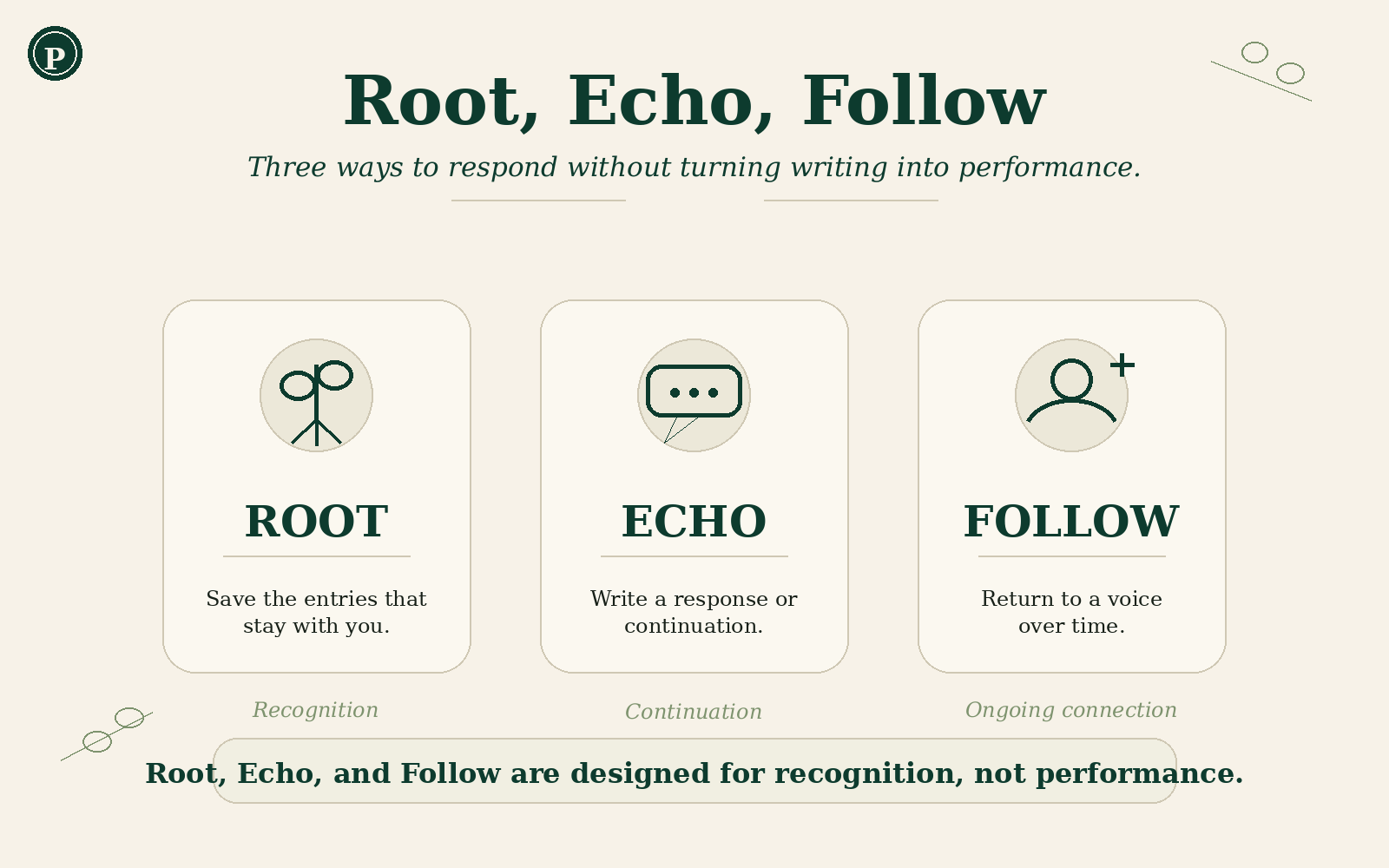
Three small verbs do most of the social work on Poplar. None of them produce a public count. None of them rank anything.
A Root is the warmer alternative to a like. It saves the entry to your Roots collection so you can re-read it, and it tells the author that someone Rooted theirs. The author sees a tally. No one else does. There's no leaderboard, no "most rooted" tab, no badge for hitting a number. It's a small acknowledgement, kept between writer and reader.
An Echo is your own entry, written in reply to theirs, which links back so a reader can trace the thread. Echoes branch. One Poplar can grow a small tree of replies, anonymous and signed mixed together, each one its own honest piece. You're capped at three Echoes per day, and like any Poplar, you choose anonymous or signed for the Echo too.
Friends on Poplar are mutual-only. No one-way follows. Once you both accept, that person's entries appear in a separate Friends Feed, and you can DM each other. It's the only part of the app that resembles a regular social network, and it stays small on purpose.
None of this is a growth hack; it's borrowed from relationship science. When Arthur Aron paired strangers for forty-five minutes of escalating mutual self-disclosure, they reported significantly greater closeness than pairs who spent the same time on small talk.
Aron and his colleagues framed it as a lab procedure for generating temporary closeness, not romance. The three verbs run the same sequence at a gentler pace: disclosure first, connection after.
Odyssey: when you want to write together.
Some entries don't want to be a one-off. They want a collaborator. Odyssey is the place for that.
An Odyssey is a story written by multiple authors, one chapter at a time. Each chapter has a soft 300-word limit, which keeps things moving and stops any one writer from running away with the plot. You pick a privacy tier when you start one:
| Privacy tier | Who can add chapters |
|---|---|
| Private | Invite-only. Just the people you tag. |
| Friends | Open to your mutual friends to contribute. |
| Public | Open to anyone on Poplar to add the next chapter. |
When the story feels finished, the originator flips an is_complete flag and it closes. No one can add another chapter after that, but anyone can still read it. Some Odysseys are fiction. Some are letters between strangers. The shape is yours.
Streaks and Full Bloom.
Poplar has streaks, because for most writers a small nudge is the difference between a diary and a good intention. But the system is deliberately forgiving.
You have a current streak and a longest streak. The point of a streak is to keep you in the habit, not to punish you for taking a Tuesday off.
Full Bloom is the badge for posting all three Poplars in a single calendar day. Amber on your profile, the only badge in the app. No levels, no XP, no rankings. Full Bloom is a quiet acknowledgement that you had a day worth writing about three times.
What Poplar doesn't have.
A short list, because it shapes the experience as much as anything Poplar does have.
- No algorithmic feed. The five entries you see after posting are random per session. There's no ranking, no "for you" tab, no engagement-optimized stream.
- No public like count. Roots are private to the author. A reader can't see how many Roots an entry has, and the author can't compare numbers with anyone else.
- No follower count. Friends are mutual-only, and the count isn't displayed as a number on your profile.
- No paywall on the core mechanic. Writing, reading, Rooting, Echoing, friending, Odyssey, all free. The whole architecture assumes you came here to write, not to win at it.
You can't lurk. You can't broadcast. The room stays full of people who are actually writing.
Your first 10 minutes.
The onboarding gauntlet is short and deliberate. Here's what it looks like.
Frequently asked questions.
What is Poplar? +
Poplar is an anonymous social diary. You write one entry, called a Poplar, and five entries from other writers come back to you. You can choose to post anonymously or under your username, per entry. There's no algorithmic feed, no public like count, and no follower number. It's a quiet, small place to write honestly and read honestly.
Is Poplar free? +
Yes. Writing, reading, Rooting, Echoing, adding friends, and starting Odysseys are all free. There's no paywall on the core mechanic.
How is Poplar different from other journaling apps? +
Most journaling apps are a private diary you write into alone. Poplar adds one thing: the diary gets read. Five strangers see what you wrote, and you see what five strangers wrote. You can still post anonymously, so the privacy is preserved, but the loneliness of writing into a void is not.
Can I post anonymously and read what people send back? +
Yes, that's the default for your first entry, and it stays available for every entry after. Anonymity on Poplar is per-entry, not account-wide, so you can write one Poplar anonymously and the next under your username, in the same session. Most entries the average reader sees are anonymous.
How many entries can I write per day? +
Three Poplars per day, and three Echoes per day. The cap exists so the feed doesn't become a broadcast and so the habit stays sustainable. If you hit three Poplars in a single calendar day, you earn the Full Bloom badge on your profile.
What is the difference between a Root and an Echo? +
A Root is a save. You Root an entry that lands with you, which keeps it in your Roots collection for later and tells the author someone Rooted theirs. No one else sees the count.
An Echo is a reply, but written as your own entry that links back to the original. Echoes branch into a tree of replies. Roots are small and private. Echoes are public threads of writing.
Is Poplar safe? Who reads my entries? +
Other writers on Poplar read your entries, surfaced randomly to them after they post their own. There's no public web index of Poplars, and no way for a reader to find an anonymous entry back to your account. If you post signed, a reader can tap through to your bio. If you post anonymously, they see only "Anonymous" with no link back.
What is Full Bloom? +
Full Bloom is the badge for posting all three Poplars in a single calendar day. It's amber on your profile, and it's the only badge in the app. There are no levels, no XP, no rankings. Full Bloom exists as a quiet acknowledgement that you had a day worth writing about three times.
One last thing.
That's the whole machine: one entry out, five back, a handful of small verbs, and nothing keeping score. If you're curious about the thinking behind it, read why I made Poplar or what a social diary does for the habit. And if you're new to the practice itself, start here.