
Odyssey: collaborative storytelling with strangers
Odyssey lets you co-write a multi-chapter story on Poplar, one 300-word chapter at a time, with strangers, friends, or just yourself. Here's how it works.


Key takeaways
- Odyssey is multi-author collaborative fiction on Poplar: one person starts it, strangers or friends write the next chapter. You never fully control where it goes — that's the point.
- The 300-word soft limit per chapter is a feature, not a constraint. Long enough to leave your mark, short enough that the next writer has somewhere to go.
- Three privacy tiers: Private (solo drafting with structure), Friends (known audience, low social risk), Public (open to any Poplar writer — where the real surprises happen).
- Turn-locks mean chapters seal once written. You can only write forward, never edit the past. Don't join a public Odyssey if you need full control.
- Leave every chapter open, not closed. Your chapter is a handoff, not a finale.
A story you don't fully control.
Most collaborative writing tools assume you already know who you're writing with. You share a Google Doc with a co-author, a writing partner, a friend who agreed to the project. Odyssey on Poplar starts from a different premise.
You write the first chapter, and then a stranger writes the second. Then another stranger writes the third. You don't fully control where the story goes, and that's the point.
This is not for everyone. If it is for you, it's a kind of magic that no shared doc has ever produced.
What an Odyssey is on Poplar.
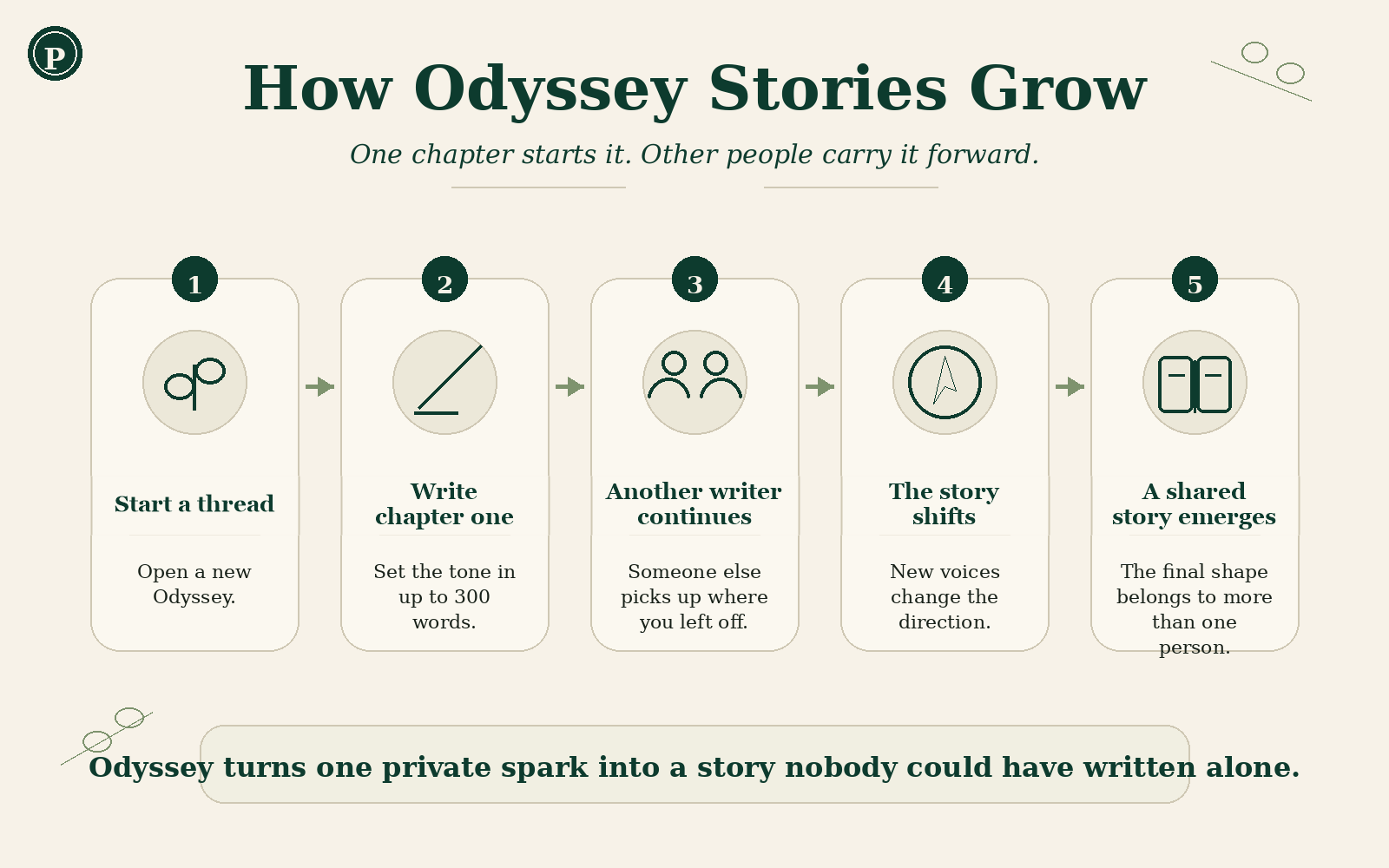
An Odyssey is a multi-author story on Poplar. One person starts it. They give it a title, pick a privacy tier, and write the opening chapter. After that, every chapter is written by a different author who picks up where the prior chapter ended.
Chapters are numbered. Each one has its own attributed author. Signed writers show their username under the chapter; anonymous writers appear as Anonymous, the same way regular entries do. Attribution is per chapter, so a finished Odyssey has many voices on the byline by design.
This is the closest Poplar gets to fiction.
Most of Poplar is diary writing, traded one entry for five via the Poplar exchange. Odyssey is the part that turns outward and invites other people in.
The shape is older than the app. In 1925 the Surrealists Yves Tanguy, Jacques Prévert, André Breton, and Marcel Duchamp turned an old parlor game into the cadavre exquis. Tate's art-terms glossary describes the mechanics: each player added to a composition, folding the paper to conceal their contribution, then passed the sheet along.
The name came from the first sentence the game produced, "the exquisite corpse will drink the new wine." A century later, the Museum of Modern Art keeps six exquisite corpse works in its online collection. The Surrealists hid every turn behind a fold. On Poplar the past chapters stay open; only the future is hidden.
How a chapter works.
Each chapter is rich text. You write it in a focused editor with a live word counter at the bottom of the screen. There's a full-screen compose mode if you want to disappear into the page.
300 words. That's the soft limit per chapter, shown live in the editor.
The 300-word soft limit matters. It's a nudge, not a hard cutoff. The point of an Odyssey is rhythm and turn-taking, not one author monologuing for 1,200 words. Three hundred is roughly one good scene, one strong character beat, or one well-placed cliffhanger. Long enough to leave your mark, short enough that the next writer has somewhere to go.
The three privacy tiers.
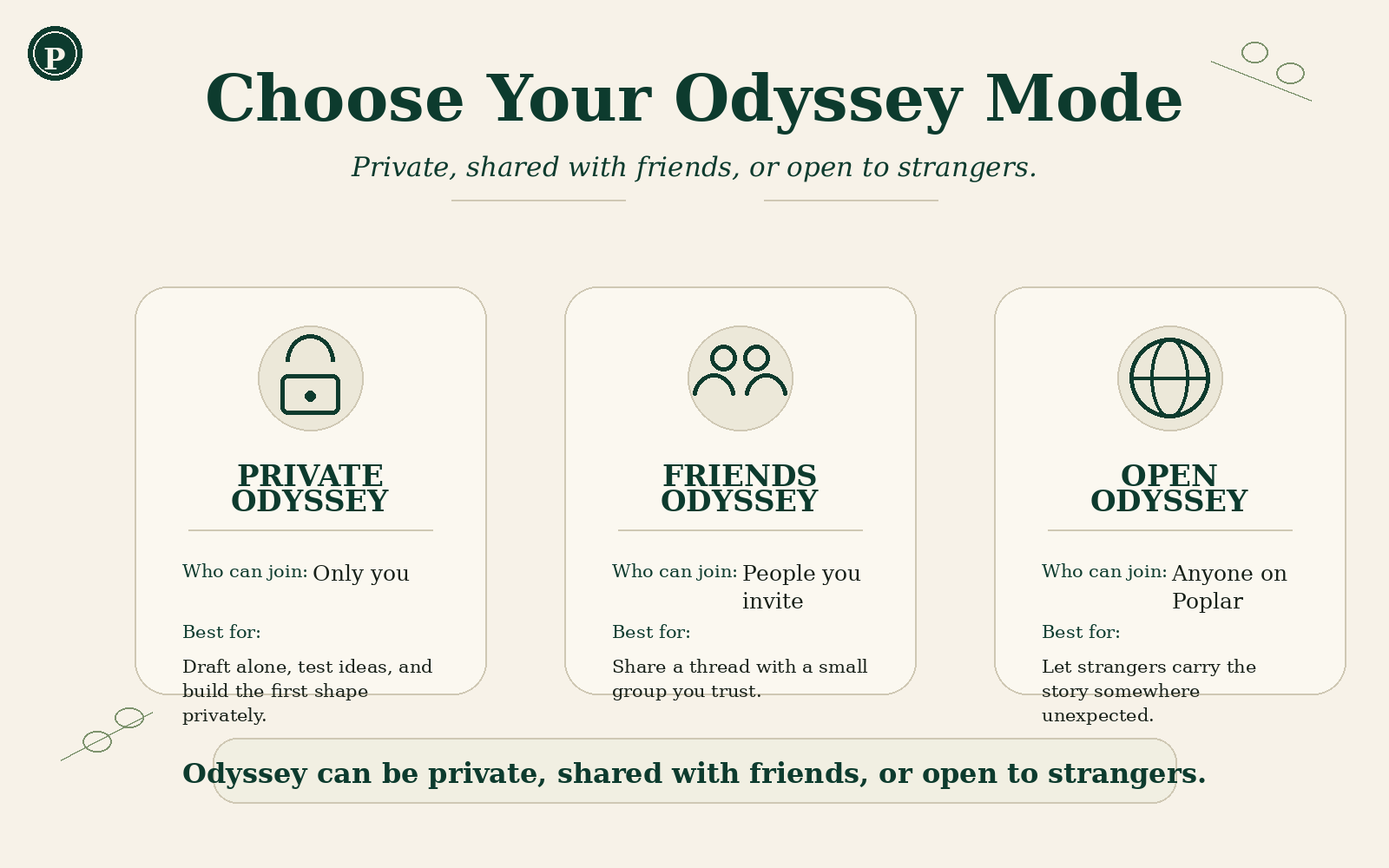
When you start an Odyssey, you pick one of three privacy tiers. Each one creates a very different kind of story.
Sounds like a contradiction, but a Private Odyssey is a way to draft a multi-chapter story alone with the same chapter-by-chapter pacing, without anyone else watching. A long-form fiction sandbox, or a serialized journal, one chapter per sitting.
This is the tier most people start with. Small, trusted, and you know roughly what voice each contributor will bring. Low social risk.
This is the full Odyssey experience and it's the one that produces the surprises. You write your opening. The next morning a stranger has taken your protagonist into a thunderstorm. By chapter six the story has three locations and a side character you never imagined. Public Odysseys are the closest thing Poplar has to live theater.
Pick Private when you want to draft alone with structure. Pick Friends when you want the safety of a known audience. Pick Public when you want to find out what other people see in the world you started.
Starting your first Odyssey.
The practical steps are short. Open Poplar, start a new Odyssey, give it a title, pick the privacy tier, write chapter 1.
The harder part is the opening chapter. A good chapter 1 does three things. It sets a place. It puts a person in that place. It ends with something unfinished.
Not a literal cliffhanger every time, just something the next writer can pick up and move. A character about to open a door. A decision not yet made. A line of dialogue waiting for a response.
Contributing to someone else's Odyssey.
If you're writing chapter 4 or chapter 7, your job is different. You're a guest. The world already exists. The characters have a voice. Your contribution should feel like the next breath, not a new song.
The etiquette is mostly common sense. Read the whole story first, not just the prior chapter. Match the tone, even if it's not your default. Don't introduce a brand-new protagonist mid-story unless the story is asking for one.
The failure mode is older than the internet. In 1907 Harper's Bazar began serializing The Whole Family, a round-robin novel written in twelve chapters by twelve authors, William Dean Howells and Henry James among them, each chapter voiced by a different member of one New England family.
Howells had imagined a controlled experiment. Then, as June Howard documents in Publishing the Family, Mary E. Wilkins Freeman took the character everyone assumed was a quiet spinster aunt and reinvented her as vivacious and marriageable, and the rest of the novel spiraled in directions nobody had planned. Every contributor after chapter 1 is a potential Freeman. That's the deal you accept.
Leave the ending open, not closed. Closed endings turn an Odyssey into a short story with extra steps. Open endings keep the chain alive. Your chapter is a handoff, not a finale.
An Odyssey is the only co-writing format where it's a rule, not a bug, that someone else gets the last word.
When to mark an Odyssey complete.
The creator can mark an Odyssey complete when it feels finished. Once it's complete, no new chapters can be added. It still lives on Poplar and other people can still read it. It's just sealed.
Some close naturally. Chapter 12 wraps up the arc, the creator marks it done, the story lives in the archive. Others sit at chapter 4 for a month and the creator closes it as a fragment, which is also fine. Not every Odyssey needs to be epic. Some are sketches.
How Odyssey differs from a shared Google Doc.
A shared Google Doc is a flat surface. Anyone with access can rewrite anything at any time. There's no turn-taking, no per-paragraph attribution, no rule about who gets to do what. It's powerful for co-editing. It's terrible for co-creating in sequence.
Odyssey enforces four things a Google Doc doesn't.
| Rule | Shared Google Doc | Odyssey |
|---|---|---|
| Turn-locks | Anyone with access can rewrite anything at any time | Once a chapter is written, it's locked; the next author can only write forward |
| Attribution | No per-paragraph attribution | Each chapter is signed by its author, so you always know whose voice wrote which beat |
| Open handoffs | No pressure to leave anything open | The format itself nudges you to leave handoffs open |
| Anonymity | Your real identity is tracked in every revision | You can write a chapter anonymously, the same way you can journal anonymously on Poplar |
The turn-based, written format has quiet evidence behind it. In 2000 the psychologists Paul Paulus and Huei-Chuan Yang studied what they called brainwriting: ideas written silently on slips of paper and exchanged within the group, a cousin of the exquisite corpse. Groups that shared written ideas outperformed groups that did not, both during the exchange and when writing alone afterward.
Face-to-face brainstorming has a famously poor record in that literature. Writing in turns is the documented exception.
Odyssey isn't trying to replace Docs. It's a different shape. Draft a business plan with a colleague? Use Docs. Write a piece of fiction with people you barely know? Odyssey is the better surface.
When not to use Odyssey.
Odyssey is wrong for a few things and it's worth being honest about that.
Use a regular Poplar entry or a notebook. Private Odyssey works, but if no one else will ever read it, you're better off in a regular diary entry.
Odyssey is too slow. Chapter pacing means hours or days between turns.
The turn-locks will fight you. That's a Google Doc job.
Odyssey shines when the goal is collective surprise, not a polished single-author manuscript.
Frequently asked questions.
What is an Odyssey on Poplar?+
A multi-chapter story written by multiple authors. One person starts it with a title and a privacy tier. Every subsequent chapter is written by a different author, picking up where the previous chapter ended. Chapters are numbered in order.
How long can each chapter be?+
The soft limit is 300 words per chapter, shown live in the editor as you type. It's a nudge, not a hard cutoff, but staying near it keeps the story moving and leaves room for the next writer.
Who can read my Odyssey?+
Depends on the privacy tier you picked. Private means only you. Friends means only your mutual friends on Poplar. Public means anyone on Poplar can read it, and anyone can write the next chapter.
Can I invite specific friends to write with me?+
Yes. When you create an Odyssey, you can invite specific Poplar users to join. Beyond the initial invite, whoever has access under your chosen privacy tier can contribute.
What happens when I run out of writers?+
Nothing breaks. The Odyssey sits at its current chapter count until someone picks it up or until you mark it complete. There's no penalty for one that pauses.
Can I edit someone else's chapter?+
No. Chapters are locked once written. This is the turn-lock rule. You can only write forward in your own chapter, not rewrite the past.
Can I write anonymously in an Odyssey?+
Yes. The same anonymity model that powers anonymous journaling on Poplar applies here. Your chapter can appear under your username or as Anonymous.
What if a chapter takes the story in a direction I don't like?+
You write the next chapter and redirect it. Or you accept that the story is now partly someone else's. Both are valid. What you don't get to do is delete or rewrite the chapter you didn't like. That's the trade you made when you picked Public or Friends tier.
One last thing.
Odyssey is the strangest thing on Poplar and probably the most fun. Start one. Pick a privacy tier. Write 300 words. See who shows up.
Read more about how Poplar works, the benefits of a social diary, and what makes writing stick.