
The benefits of a social diary
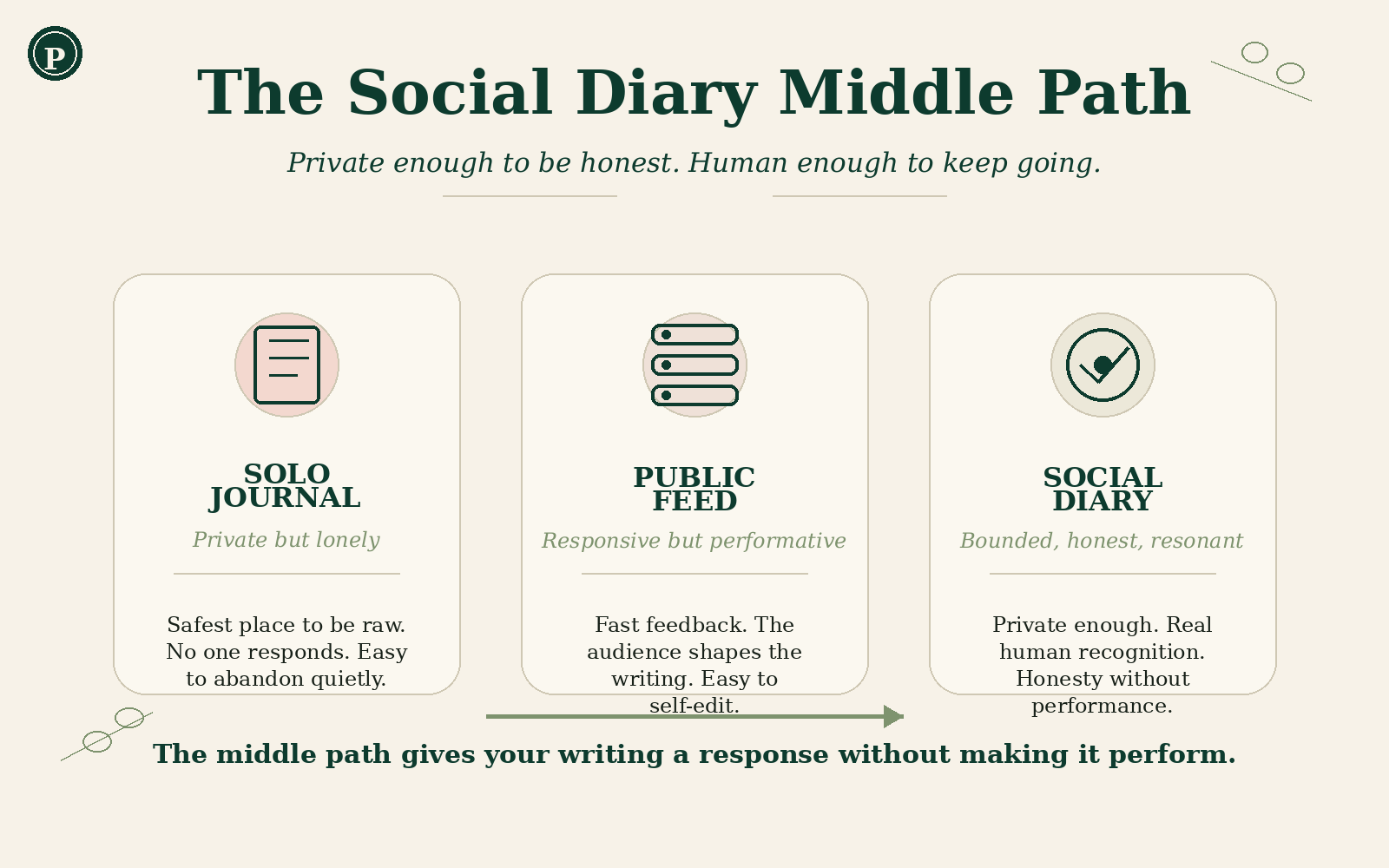
Solo journals die. Broadcast posts perform. A social diary sits in the middle: you write one entry, five real entries come back. Here is what that actually buys you.


Key takeaways
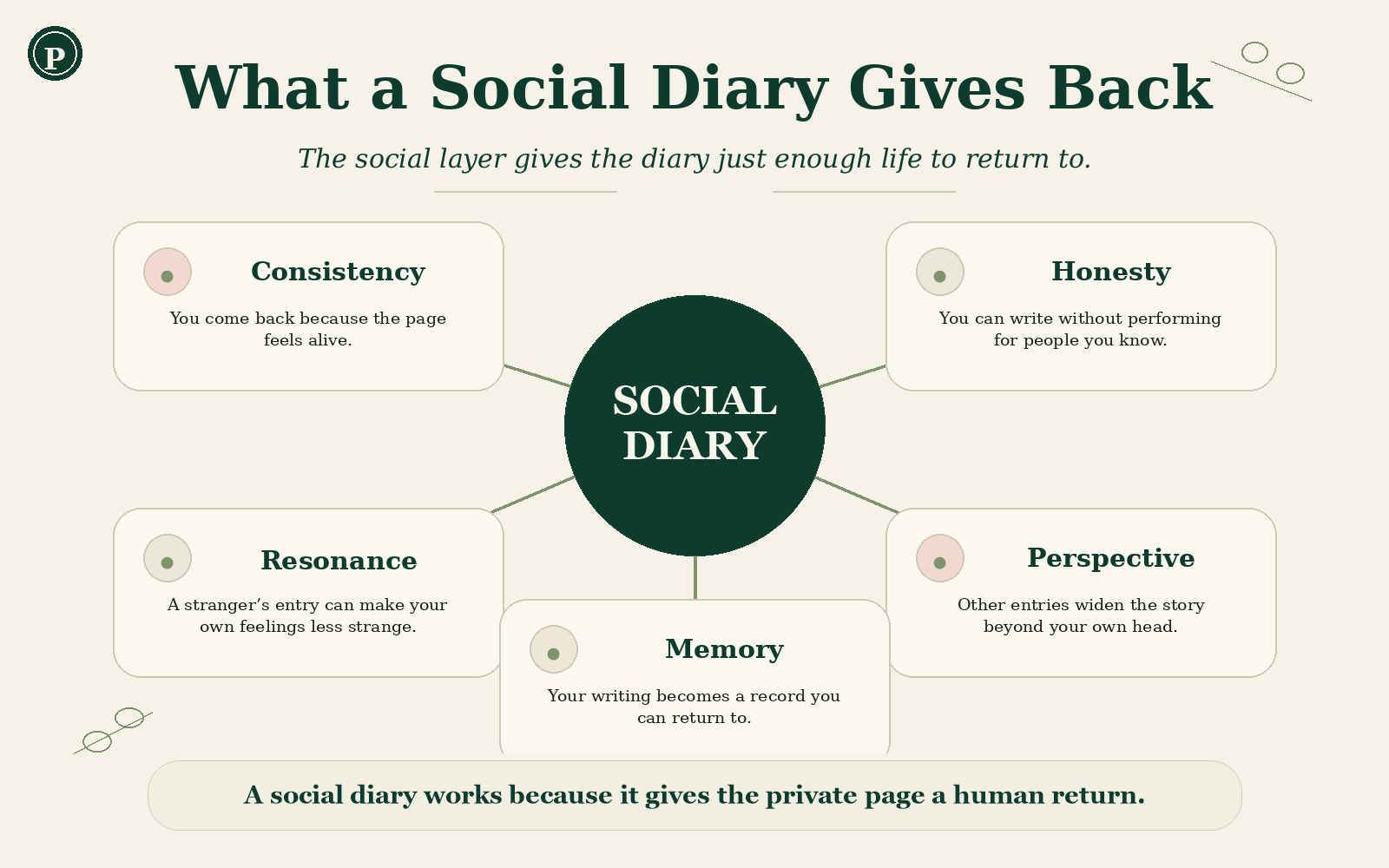
- Solo journals die when writing stops feeling like it's for anything. A small real audience — not a crowd, just five readers — removes the most common reason people stop.
- Anonymity per entry takes the cost of the audience off the table for the writing that needs it. Write the honest version today, the proud one tomorrow, same account.
- Roots are private saves, not public counts — they build a quiet commonplace book of what helped, readable months later when a similar week comes around.
- The accountability that works is built into the trade itself: you write because five entries are coming back. Streaks just keep the loop visible.
- The friendships that form tend to be quiet and durable, because they were built on honest writing first, then social — in that order.
Why solo journals die.
Solo journals tend to die. Not because the writer ran out of feelings, but because writing into a void starts to feel like a chore after a while. Meanwhile, the broadcast version of writing your life, the social media post seen by your boss and your ex, comes with a different cost. You start writing for the room, and the writing gets thinner.
A social diary sits in the middle. You write a real entry the way you would in a notebook, send it out, and a small handful of real entries from other people come back. No follower counts, no public likes, no algorithm picking what you see.
The benefit is not that strangers cheer for you. The benefit is that someone is on the other side of the page, which turns out to be the difference between keeping a habit and quietly abandoning it. This is what a social diary, the specific shape of one we built into Poplar, is really for. We will keep it concrete.
What a social diary is, and what it isn't.
A social diary is a writing surface where reading and writing are part of the same loop. In Poplar's version, the loop is simple. You write one entry, called a Poplar. Five Poplars from other writers come back to you that day. The cap is three Poplars per day, so the feed is small, finite, and readable.
Each entry can be signed or anonymous, and the choice is made per entry, not per account. The person who shared a hard week on Tuesday under a pen name can post a photo of their dog on Friday with their real name attached.
Inside that frame you get the four building blocks: Poplars, Roots, Echoes, and Friends. Roots are the warmer version of a like, saved to a private collection. Echoes are reply-as-entry, capped at three a day, branching into a small tree. Friends is opt-in and mutual, with its own feed and DMs.
Poplars
Write one entry, and five from other writers come back that day.
Roots
The warmer version of a like, saved to a private collection.
Echoes
Reply-as-entry, capped at three a day, branching into a small tree.
Friends
Opt-in and mutual, with its own feed and DMs.
It is not a social network. There is no scroll. There is no public follower count visible to readers. There is no algorithmic feed. There is no paid tier sitting on top of the core trade. The whole thing is one writer giving an entry to get a few back.
No. 1 of 5: You actually keep writing.
Most journaling habits fail at the same place: the moment writing stops feeling like it is for anything. The page closes. A week passes. The blank entry on Sunday starts looking like homework. Solo journals are good at intrinsic motivation when you have it, and they are unforgiving when you do not.
The social diary changes one variable. Someone is reading. Not a crowd, not your followers, just a few real people who also wrote something today.
Nobody has run the trial on diaries with an audience of five, so call this conviction rather than science. You write because the entries that come back are good, and the entries that come back are good because everyone writing them is doing the same trade you are. That is the engine.
The benefit is not that strangers cheer for you. The benefit is that someone is on the other side of the page.
There is a real version of this and a fake version. The fake version is a like-count climbing on a public post. The real version is one Echo on a hard entry that you reread three times. Poplar is built for the second one.
No. 2 of 5: Perspective from strangers without the cost of strangers.
Most of what makes social media corrosive is the cost of the audience. You know who is watching, which means you start writing for them. You soften the thing you would have said. You skip the entry that mentions the rough year. A whole layer of honesty gets shaved off before the first word.
That cost shows up in the data on the broadcast platforms themselves. When psychologist Ethan Kross's team texted eighty-two young adults five times a day for two weeks, the more time someone had spent on Facebook between check-ins, the worse they felt at the next one. Direct contact, face-to-face or by phone, predicted the opposite.
Where anonymity comes in.
Anonymity per entry takes that cost off the table for the writing that needs it. You can write the honest version under a pen name today, and you can write the proud one with your name attached tomorrow, from the same account.
Nobody on the receiving end is going to follow you back, because Poplar does not have a follow graph. They cannot screenshot a like count and use it against you, because there isn't one.
What you do get is the strange and underrated thing that strangers are uniquely good at: showing you that the thing you assumed was just you is not just you. That is the part that self-reflection alone cannot reach. A friend will reassure you.
A stranger writing about the same week will tell you the truth by accident, because they did not know it was about you.
The loneliness research backs this from an unexpected angle. When Christopher Masi and John Cacioppo's team pooled fifty studies of loneliness interventions, the rigorous randomized trials showed a modest but reliable reduction, and the most successful programs were not the ones offering more social contact or social skills. They were the ones that changed how lonely people read social situations.
Which is, quietly, the work a stranger's entry does.
No. 3 of 5: Saving what helped.
One sentence from someone else's entry can do real work. You read a Poplar that names the thing you were trying to name about your week. You want to remember it. On most platforms, the only move is to hit a heart, which lights up briefly and disappears into a count.
Roots are the slower version. You Root an entry, and it goes into your private collection.
Over a month, the collection becomes a quiet record of which writers and which sentences helped, which is closer to a commonplace book than a like history. People go back to their Roots when a similar week comes around. That is a benefit you cannot get from a feed designed to forget last Tuesday by Wednesday morning.
If you want a feel for what the saved-entries pile looks like, the diary without likes piece walks through the design choice in more detail.
No. 4 of 5: Gentle accountability.
Accountability in most apps means a shame loop. Miss a day, lose the streak, see the broken flame icon, feel a little worse, open the app a little less. If you have lived through that loop, you know it does not produce more writing in the long run. It produces guilt-driven bursts followed by long silences.
The social diary version is lighter on purpose. Streaks exist, because they help.
Full Bloom is the small badge for writing three entries in one day, and it is silent: nobody else sees it. The point is to mark the days that mattered to you, not to build a public scoreboard.
The accountability that actually works is the one already built into the trade itself. You write because five entries are coming back, and you read because somebody waited for the entry you sent. That is the loop. The streaks just keep the loop visible.
No. 5 of 5: The rare friendships.
Almost all the writing on Poplar stays among strangers and pseudonyms, and that is the design. But there is a quieter benefit that shows up after a few months. You start noticing the same writer's voice. They Rooted three of your entries in a row. You did the same for theirs. You both wrote about the same week from opposite sides of it.
There is a famous experiment underneath this. When psychologist Arthur Aron had pairs of strangers trade forty-five minutes of increasingly personal questions, they left the lab feeling closer than pairs who made small talk for the same stretch. Escalating, mutual disclosure is the mechanism. A diary that trades honest entries runs the same mechanism, slower and in writing.
Friends is opt-in and mutual, so it only happens when both writers want it. Once you are friends, you get the Friends Feed and DMs, and the rest of the diary stays exactly as it was.
The friendships that form here tend to be quiet and durable, because they were built on writing that was honest first, then social, in that order.
If you are curious about how the friend layer works mechanically, the how Poplar works page covers it end to end.
What it does not promise.
A social diary is not therapy, and it is not a productivity trick. It will not turn writing into a dopamine machine, on purpose. The whole point is the opposite: a writing surface with a working incentive to come back tomorrow, not a feed that wants your attention all day.
What the writing itself does.
The private benefit is older than any app. When psychologists James Pennebaker and Sandra Beall ran the first expressive-writing experiment in 1986, students who wrote about their hardest experiences for fifteen minutes a day, four days running, made fewer trips to the health center in the months that followed.
The honest footnote: the picture since is more modest than the legend. The largest meta-analysis of the tradition, run by psychologist Joanne Frattaroli across 146 randomized studies, finds a positive but small average effect across health and psychological outcomes. Small, and real. Writing about hard things helps; it is not a cure, and we have never sold it as one.
A small, real audience adds one specific thing on top of that private benefit. It keeps you doing it. It does not replace the work of putting your week in words. It removes the most common reason people stop.
Frequently asked questions.
What is a social diary?+
A social diary is a journal where reading and writing are part of the same loop. You write a real entry, and a small number of real entries from other writers come back.
Poplar's version is one entry out, five back, with a cap of three per day. There is no public like count, no follower graph, and no algorithmic feed. The audience is small and finite by design.
How is Poplar different from journaling apps like Day One or Reflect?+
Day One and Reflect are private notebooks with very good formatting. They work well if you already have a strong solo writing habit. Poplar is built for the writers who keep starting and stopping.
The difference is the incentive to come back: a few real entries from other people land in your feed only when you write. Most people who try Poplar end up using it alongside a private notebook, not instead of one.
How is Poplar different from social media like Twitter or Instagram?+
Twitter and Instagram are broadcast products. The audience is large, public, and indexed, which warps what people are willing to post. Poplar is the opposite shape: small audience, no public follower count, anonymity available per entry, and a cap of three entries a day. You are writing for a few real readers who are doing the same trade, not for a feed that ranks you.
Will my entries be public?+
Your entries are only seen by writers who got them in their five-back batch that day. They are not indexed by search engines, they do not appear on a public profile feed, and there is no public like count attached.
You can also write entries anonymously, on a per-entry basis, and switch back to your name on the next one. How to journal anonymously online goes into more detail.
Can I make friends through Poplar?+
Yes, and slowly. Friends on Poplar is opt-in and mutual, so it only happens when both writers want it. Most friendships start after a few months of Rooting and Echoing each other's entries.
Once you are friends, you get a Friends Feed and DMs, and the rest of the diary stays the same. There is no public friend count and nobody sees who is on your list.
Is reading other people's diaries weird?+
It is the first question almost everyone asks, and the answer is no, once you have done it for a week. Every entry you read came from someone who wrote it knowing it would be read by five strangers.
The writers are not being surveilled, they are participating in the same trade you are. The closest analogy is reading a few real letters from people you do not know, who do not know you either.
What if I don't want anyone to read what I write today?+
Write it anonymously. The anonymity choice is per entry, not per account, so nothing about today's entry is connected to the entries you signed before or will sign tomorrow. You can also keep certain reflections in a separate private notebook and only post the parts you want to send out. How to start journaling covers the mixed model in more depth.
Do I have to use a real name?+
No. You pick a username after your first entry, and the username can be anything you want. Many writers on Poplar use a pen name and never attach their legal name to anything. The trade still works either way, because nobody on the receiving end is choosing whether to read you based on who you are.
One last thing.
If you want to try the trade, you write one Poplar, anonymously if you want, and five come back. You can pick a username later. The first entry takes about three minutes. The rest is up to you and whoever is writing on the other side of the page tonight.