
How to start journaling when you don't know where to begin
If you've been meaning to start a journal for months and the notebook on your shelf is still on page one, this is for you. A short, kind guide to writing the first entry and keeping the habit alive.


Key takeaways
- Three sentences is a complete first entry: one thing that happened, one feeling, one wondering — write it tonight in under three minutes
- The three real blockers are not knowing what to write, fear of being read, and first-entry pressure — all three have simple, immediate fixes
- Paper and digital both work; the right format is whichever one you'll actually open tomorrow night
- Daily journaling that survives the first month is smaller, sloppier, and more forgiving than the version you tried before
- The journal that gets written in beats the beautiful one sitting in a drawer — start with whatever is nearest, right now
You've been meaning to start a journal for a while now, and that's okay.
Most people who want to start journaling don't, because they're waiting for something. The right notebook. A quiet morning. A clear head. A version of themselves who has more to say. The wait is the obstacle. Almost nobody has ever started a journal feeling ready.
This guide is for the version of you who is reading this between tasks, on the couch, mildly tired, with a brain that has been louder than usual lately. The version who has read other "how to start journaling" pieces and walked away thinking it sounds nice but not quite right for me.
What follows is short. Why people actually journal. Why you keep not starting. A first entry you can write tonight in three minutes. An honest comparison of paper versus apps. The styles worth trying. Ten things to write when you don't know what to write. And what to do the morning after the day you skipped, because that morning is going to come.
Why start journaling now, not next year.
People come to a journal for one of four reasons. Naming yours out loud is the first useful thing you can do tonight.
The looping thoughts that wake you up at 3 a.m. get smaller on the page. Not gone. Smaller.
You'll find your real opinion about a job, a person, a year, only when you write it down. Conversations give you the socially acceptable version. The page gets the rest.
A year from now you won't remember this week. Three sentences a night gives you something to look back at.
Writing about a decision is faster than thinking about it. The act of putting it into sentences forces the shape of the question into view.
None of these reasons is wishful thinking. When the psychologist James Pennebaker ran the first expressive-writing experiment in 1986, students who wrote about the hardest experiences of their lives for fifteen minutes a day, four days running, made fewer trips to the health center over the months that followed.
Four decades of studies later, the honest summary is quieter. The largest meta-analysis of the field, Joanne Frattaroli's pooling of 146 randomized studies, found a positive but small average effect on health and psychological outcomes. Small, real, and not instant. The first sessions of writing about hard things often feel worse before they feel better.
Pick whichever fits. You can change it next month. The reason is just the door in.
Why you keep not starting.
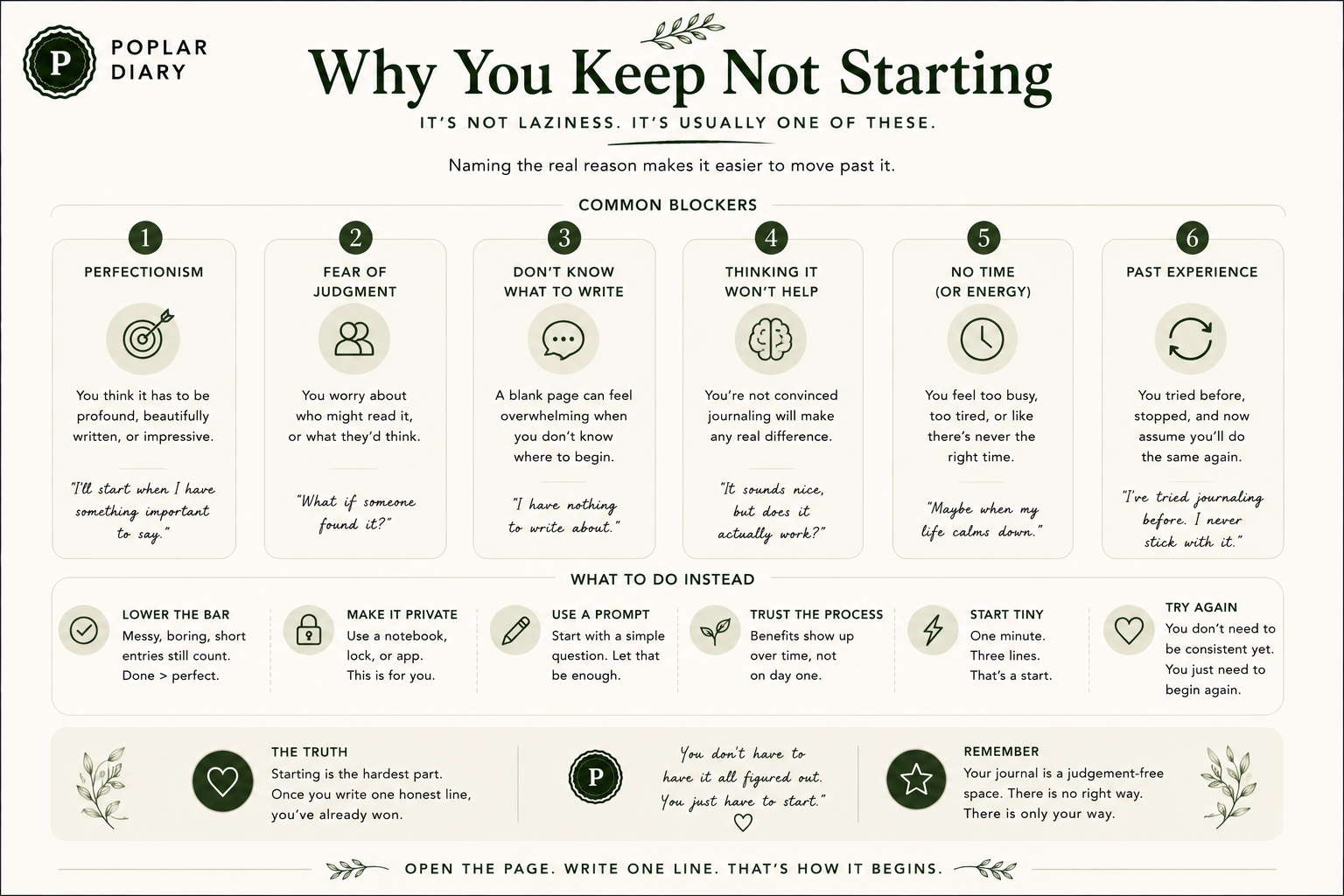
If you've been meaning to start journaling for more than a month, the obstacle is almost certainly one of these three:
- You don't know what to write. You sit down, the page is blank, your brain offers seventeen things at once, and none of them feel like the right place to start. So you don't start.
- You're worried about what would happen if someone read it. A roommate, a partner, a parent who used to read your diary when you were twelve, a future version of yourself you don't want to confront. The page feels exposed in a way you can't quite name.
- You think the first entry is supposed to mean something. A beautiful opening line. A clear intention. A "today I begin" framing. None of that is true. Almost every long-time journaler's first entry is some version of "I don't know what I'm doing but I'm going to try this."
Three obstacles, three fixes. The fix for not knowing what to write is a prompt. The fix for being worried about being read is a private or anonymous surface. The fix for the first-entry pressure is the lower-stakes first entry below.
A first entry you can write tonight in three minutes.
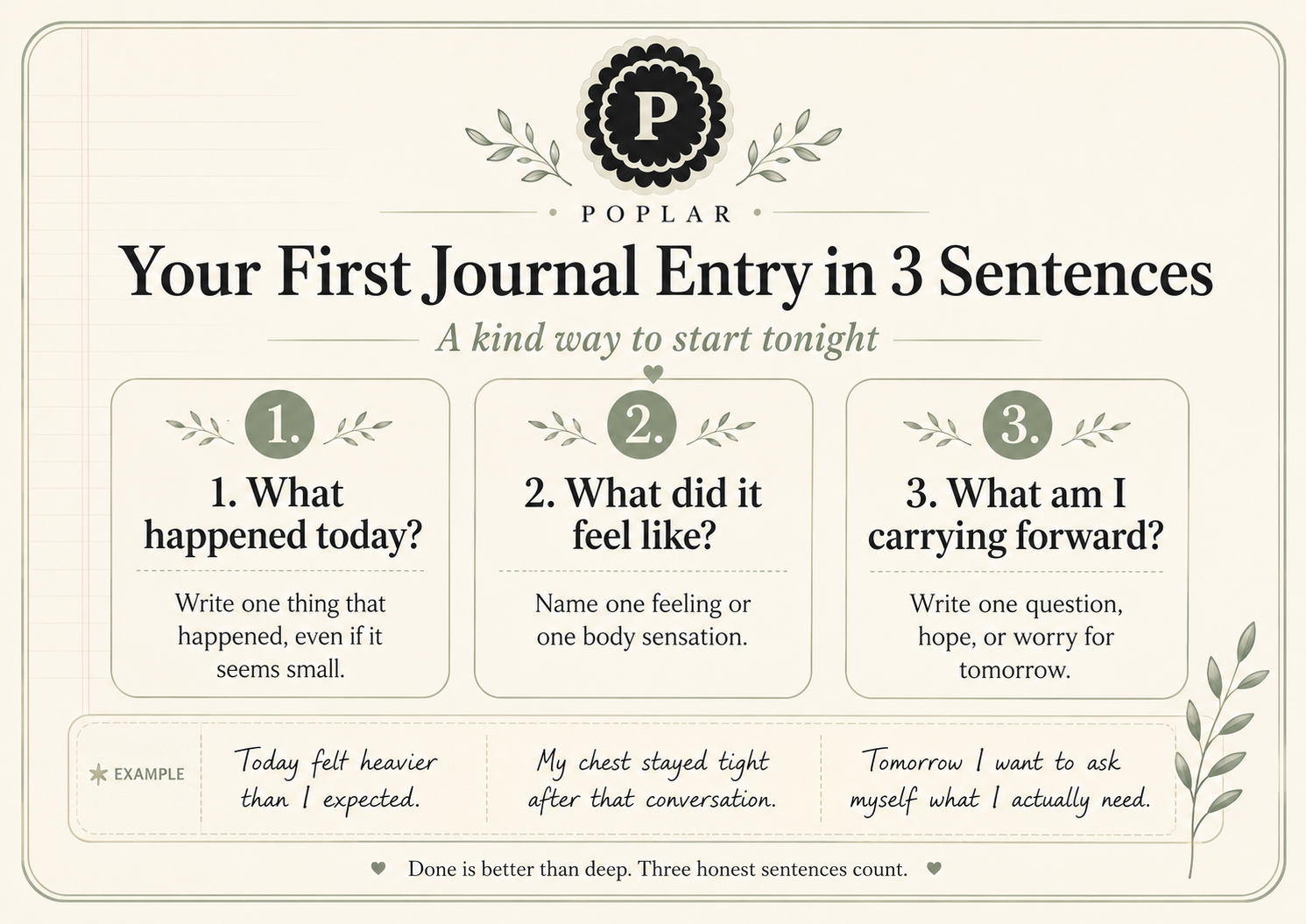
Open a notes app, a notebook, a Google Doc, whatever's nearest. Write today's date at the top. Then write three sentences, in this order:
That's a complete first entry. Three sentences. Three minutes. The journal exists now.
Don't reread it. Don't make it longer. Close the notebook or the app.
The version of you who has been waiting to start a journal for months will be slightly less heavy tomorrow morning because of those three sentences. Not because they were good. Because you wrote them.
Writing your first Poplar, anonymously, in three minutes.
If the notebook still feels too quiet and the notes app still feels like writing into a void, the three-sentence entry above is also exactly the shape of a first Poplar.
Open the site, sign up, and the first screen asks you for one entry. Twenty characters minimum, no title, no streak counter, no audience. Write your one thing that happened, one feeling, one wondering. Hit submit.
The first Poplar goes out anonymously by default. You don't pick a username yet. You don't write a bio. You haven't named yourself to the room. That happens after, on the next screen, once you've already done the hard part.
The hard part happens before anyone knows your name.
Why this beats writing into a void.
Most of us used to keep a journal, then stopped, because nobody read it and writing into a void started to feel like a chore. The fix isn't going to social media. The fix is a small, slow room where the writing comes first and the identity comes after.
The moment you submit, five strangers' entries swipe through as cards. People who wrote on a similar night, in similar weather, with a similar kind of louder-than-usual brain. You read three or four, you don't reply, you close the tab. That's the whole loop. Three sentences out, five sentences in, no performance in either direction.
How Poplar works goes deeper on the limits (three entries a day, no comments, no likes). For tonight, the only thing to know is that the first entry is already small enough to write.
Picking a medium: paper or digital.
There is no right answer. There is the one you'll keep using and the one you won't. Here's how to think about it.
| Consideration | If you choose paper | If you choose digital |
|---|---|---|
| Pace | You're more likely to slow down. Handwriting forces a pace that types-and-deletes don't. The friction is the feature. | You're more likely to keep going. Phones are always nearby. The friction of remembering to bring a notebook is real. |
| Looking back | You can't easily search it later. A paper journal is for the moment, not the archive. | You can search, tag, password-protect, back up. Useful if you ever want to look back at a specific period. |
| Where it lives | You have to carry it. The journal that lives in a drawer becomes the journal that stops getting written in. | You have to be careful where it lives. The notes app shared with iCloud and visible to a partner is not private. The journaling app with a passcode is. |
| The lower bound | A cheap notebook and any pen. Don't buy the beautiful one yet. | The notes app already on your phone. Don't sign up for anything yet. |
If you genuinely cannot decide, use the notes app for two weeks. If you've written four times, get the cheap notebook. If you've written zero, the notes app wasn't the problem. We'll come back to that.
The journaling styles worth knowing before you pick.
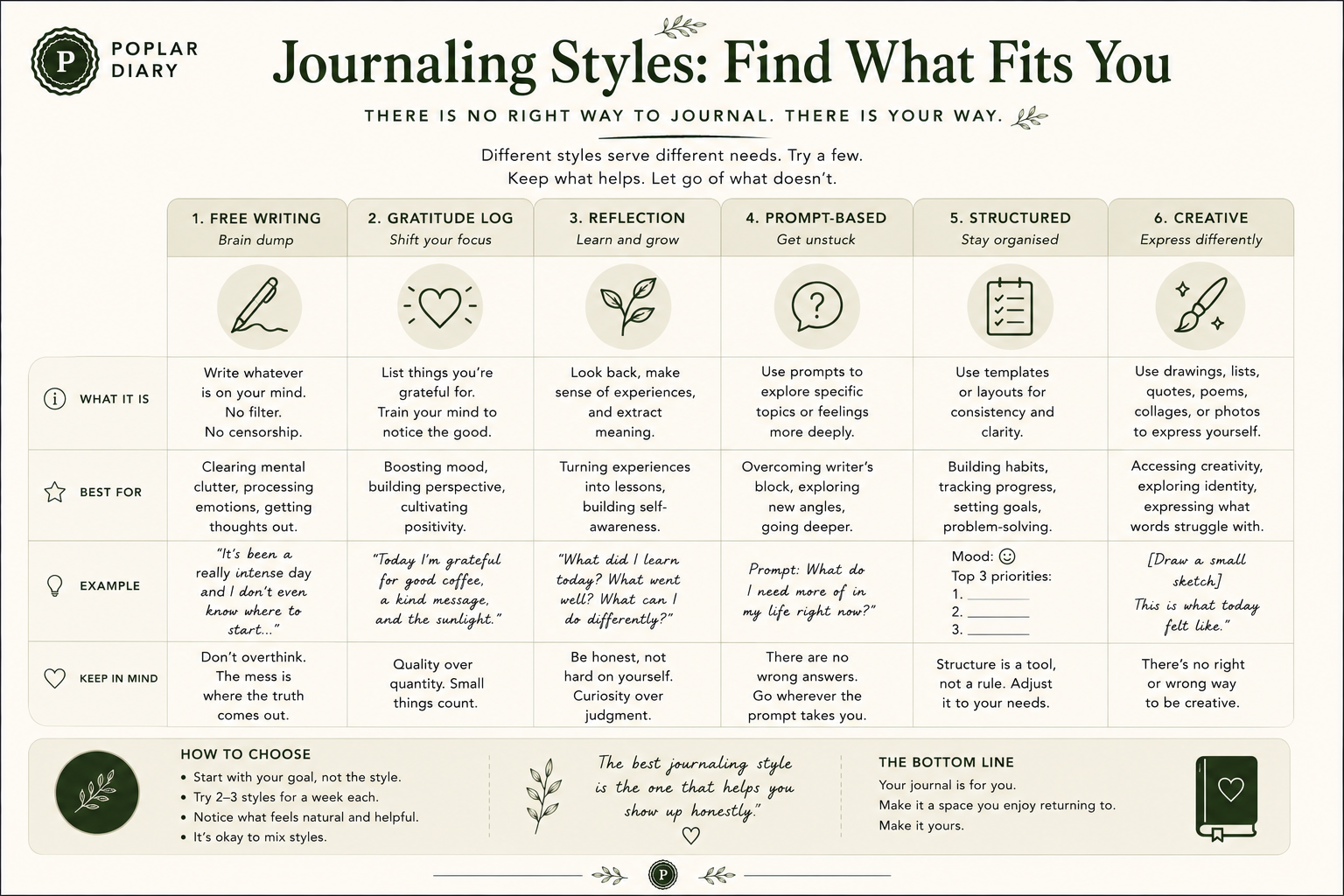
Most beginner guides skip this part and just say "write whatever comes to mind." That advice is fine for some brains and useless for others. Four styles that survive contact with real life. Pick one for the first month.
Open page, write whatever shows up, don't edit. Worst for people who freeze when given an open page.
A question you answer. "What was the loudest thing in my head today?" Worst for people who treat every prompt as a school assignment.
Three things you're grateful for, no analysis. Worst for people who use it to skip over what's actually hard.
Short structured entries paired with task tracking. Worst for people who'll spend three hours on the system and zero on the writing.
There's also reflective journaling, which sits between free-writing and prompt-based. Save that for once the practice is established.
What to write when you're not sure what to write.
Ten prompts that work for almost any night. Pick one, write for five minutes, stop. If you want a longer list once you're past the first week, the full journaling prompts page has a few hundred organized by mood and situation.
For almost any night
- What happened today that I'd want to remember in a year?
- Where in my body am I holding the day right now?
- What's the loudest thought in my head right now, on the page so it has somewhere to live besides my head?
- What did I avoid today, and what was the avoiding really protecting me from?
- What's one thing I did well today that I'd notice immediately if someone else had done it?
- If today were a season, which one, and why that one?
- What's the next small step I've been putting off, and what would the first ten minutes of doing it look like?
- What's something I'm allowed to want that I haven't admitted to wanting yet?
- What did I overhear or read today that has been quietly turning over in my head since?
- What would I tell tomorrow-morning-me about tonight, if I knew she would read it?
When to journal, and how long for.
Two questions every beginner asks, two short answers.
When. Whenever you'll actually do it. Morning works if you want to set the tone of the day before the day touches you. Night works if you want to put the day down before sleep. Nobody has convincingly shown one beats the other. Pair it with a habit you already have.
How long. Three minutes is enough to start. For calibration: the standard dose in the expressive-writing studies, per Baikie and Wilhelm's clinical review, is fifteen to twenty minutes per session, across three to five sessions. That's the whole documented protocol, and you can grow into it. Most useful entries land between one paragraph and one page.
The number of minutes isn't the practice. The showing up is.
How to make it a habit without making it a chore.
The habit research is more specific than the posters suggest. When Phillippa Lally's team tracked ninety-six people each repeating one small daily behavior, becoming automatic took anywhere from 18 to 254 days. The famous 66 days is just the median. There is no magic third week.
The other dependable finding is that plans beat intentions. Gollwitzer and Sheeran pooled ninety-four tests of goal pursuit and found that an if-then plan, meaning you decide in advance exactly when and where you'll act, had a medium-to-large effect on whether people followed through.
The practical version.
Pick a cue. Most journalers anchor to one of three: making coffee in the morning, brushing teeth at night, getting into bed. Choose whichever one is already non-negotiable. The journal lives next to the thing that triggers it. The phone-app version is a daily 9pm reminder.
Then set the bar comically low. Not "I will journal for fifteen minutes every night." That's an aspiration. Try "I will write one sentence after I brush my teeth." That's a habit, and it's also an if-then plan.
Some nights you'll write more. Most nights you'll write the one sentence. A few nights you'll skip. Across a year you'll have written more than if you'd tried for thirty minutes daily and burned out by week three. The full case lives on how to journal daily.
A bar you can clear on your worst night is the only bar that survives the year.
The morning after you skip.
You will skip. Sometimes a week. Sometimes a month. The question that determines whether the practice survives isn't whether you skip. It's what you do the morning after.
Don't catch up. Don't write a long entry about why you stopped. Just write tonight's entry, tonight, as if nothing happened. In Lally's habit data, missing a single day made no measurable difference to whether the habit formed.
The "I'm starting again" entry is a trap. The "today" entry is the practice.
If you stopped for a stretch and you're upset about it, that's information. You probably stopped because you were going through something. The journal feels like a friend you ghosted. The fix is the same as with a real friend. Send the next message. "Sorry I disappeared. Here's where I am tonight."
The five mistakes that kill a brand-new journal.
If a journal dies in the first month, it almost always dies the same way. The patterns are predictable, which is good news, because they're also avoidable.
A $40 leather Moleskine raises the stakes on every entry. The first messy line feels like a betrayal of the object. Use a $4 notebook for the first three months. Earn the nice one.
The expectation that an entry should be long and meaningful is what makes most beginners quit. One paragraph is plenty.
Telling friends, announcing a streak online. Journaling that needs an audience becomes content. Content is not the same thing.
Going back to last week's writing in week two is almost always demoralizing. Let entries sit for a season before you reread them.
The day you break a 40-day streak shouldn't be the day you stop. But it often is, because the streak became the point. The writing is the point.
Where to write if you're worried about who might read it.
This is the one most beginner guides skip, and it stops more people from starting than all the other obstacles combined.
You don't write the same things if you know someone might read them. Maybe not today, maybe not this year, but eventually, the way diaries get found in nightstands. The fear of being read makes the writing performative, and performative journaling barely helps.
Three options that solve this:
Not a desk drawer your partner uses. A box in a closet, a zipped pocket of a bag. Boring, effective.
Most of the well-known ones (Day One, Diarium, Penzu) support a passcode or biometric lock. The notes app on your phone usually does not, unless you've set it up specifically.
Poplar is one. It's an anonymous diary that pairs you with rotating prompts and lets you write a few sentences or a few pages without anyone knowing it's you. After you post, you see a handful of other anonymous entries from strangers who wrote on a similar day. The structure is built specifically for the kind of writing you wouldn't do anywhere with your name attached, which turns out to be the most useful kind. If you started journaling because anxiety has been loud lately, the journaling for anxiety page goes deeper on the specific prompts that help.
Whichever you pick, the principle is the same. The writing surface should be somewhere you can be honest without performing. If you can't write the honest version, you'll write the polished version, and the polished version stops helping after about a week.
Frequently asked questions.
How do beginners start journaling?+
Three sentences tonight: one thing that happened today, one feeling in your body right now, one thing you're wondering about. Three minutes total. Don't reread. Close the notebook. That's the first entry. Pick a cue (after brushing teeth, with morning coffee) and do it again tomorrow.
What is the 3-2-1 method of journaling?+
Three things you learned today, two things you enjoyed, one thing you'll focus on tomorrow. It's a clean structure for evening reflection that asks you to notice instead of analyze. Useful when you're tired and want a low-effort version of the practice.
What is the 3-3-3 journal method?+
A variant: three things you're grateful for, three intentions for tomorrow, three affirmations. More positive in tone than 3-2-1. Try both for a week. Keep whichever feels less performative.
What time of day is best to journal?+
Whenever you're consistent. Morning works for people who want to set intentions and clear mental clutter before the day starts. Night works for people who want to process what happened. There's no research finding either is meaningfully better than the other. Pick the one that pairs with a non-negotiable existing habit.
How long should a journal entry be?+
Long enough that you wrote something honestly. That can be one sentence. It can be three pages. Most useful entries land between 100 and 400 words. The "right" length is the length you're willing to write tomorrow night too.
What if I miss days?+
Skip the day. Don't catch up. Don't write a long apologetic re-entry. Just write tonight's entry tonight. The discipline isn't perfect streaks. It's coming back without making a thing of it.
Do I have to journal every day?+
No. Daily is a clean target, but three nights a week is a real practice. Two nights a week is a real practice. What kills a journal isn't writing four times a week instead of seven. It's writing zero times a week for a month and treating that as proof you're not the journaling type.
What should I write in my journal as a beginner?+
Start with the three-sentence entry: one thing that happened, one feeling, one wondering. After a week, pick one prompt and write for five minutes. After a month, you'll know what you actually want to write about. Let the practice tell you what it's for.
One last thing.
Close this tab. Pick the medium that's nearest. Write the three-sentence first entry above. The notebook is on the shelf, or the notes app is in your dock. Either is fine. Today's date at the top. Three sentences. Three minutes.
The version of you in six months who has been journaling lightly since tonight will be grateful you stopped reading about how to start.