
Journaling prompts for the moment you're in tonight
Eighty prompts grouped by the kind of day you've had, not by tidy life-categories. Pick one tonight. The blank page is the hardest part, then you start, and it isn't anymore.


Key takeaways
- A prompt is a permission slip — it closes the loop of "I don't know where to start" by giving you one specific question to answer
- The evidence is early but real: in one randomized trial, fifteen minutes of positive affect journaling, three days a week, lowered anxiety in medical patients within the first month
- 80 prompts inside, grouped by the kind of night you're actually having — heavy day, mind won't quiet, something good, something unsaid, starting again, and more
- If every prompt feels stale, switch categories — staleness usually means one part of your life is over-represented on the page
- Short entries are almost always better than skipping; two sentences about why you don't want to write still counts as the practice
The blank page is the hardest part.
Not the writing itself. The moment before. The sense that you should know what to say, that the thing you're feeling should arrive in tidy sentences if only you sat down properly. So you don't sit down at all.
A prompt is a permission slip. It says: you don't have to start from nothing. Start here. Three sentences is enough. Half-sentences are enough. Cross out everything you wrote and start over, and that counts too. The journaling prompts below are sorted by the kind of moment you're in tonight, not by tidy life-categories.
What follows is eighty journaling prompts, grouped by the kind of night you're having. The day that was heavier than expected. The mind that won't quiet down at midnight. The good thing you don't want to forget.
The thing you cannot say out loud to anyone, including yourself. The version of you that's trying to make a small change. The next year you can't quite picture yet.
Scroll to the one that matches. Or don't. Pick a section you're not in right now, and bookmark it for when you are.
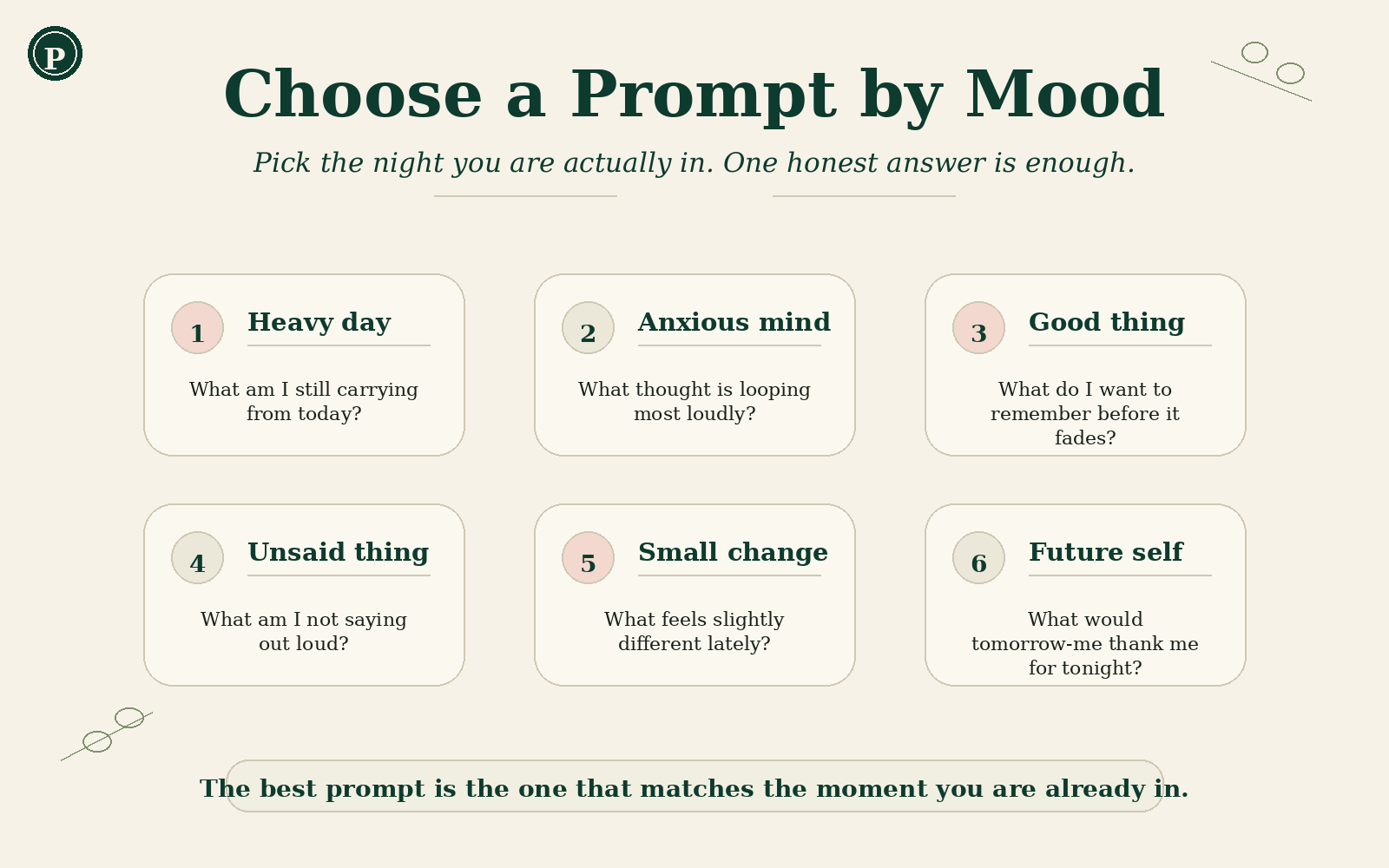
Why a prompt works when "just start writing" doesn't.
Free-writing is a beautiful idea that fails most people on a Tuesday night. You sit down, the page is white, and your brain offers four options at once: the work email, the thing your sister said, the small humiliation from 2012, the fact that you forgot to defrost the chicken. None of them feel like the right place to start, so you start nowhere.
A prompt closes that loop. It asks one specific question, which means your brain only has to answer one specific question. You're not committing to a theme or a thesis. You're answering the one in front of you, in whatever direction it pulls you.
The research is more modest than the journaling internet implies. But when psychologist Joshua Smyth and his colleagues gave seventy medical patients with elevated anxiety a web-based positive affect journaling routine, fifteen minutes three days a week, the writers reported lower anxiety within the first month compared with usual care.
"Write about your day" is a performance. "What part of today carried weight that nobody saw?" is a conversation with yourself.
A preliminary trial, the authors are careful to say. But fifteen minutes, three days a week, is a far smaller commitment than the word "journaling" tends to suggest.
The other thing a prompt does is lower the stakes. You can answer a question that specific in a sentence. You can answer it in twenty minutes. Both are correct.
If you're easing into the habit for the first time, our piece on how to start journaling walks through the gentler version of all of this.
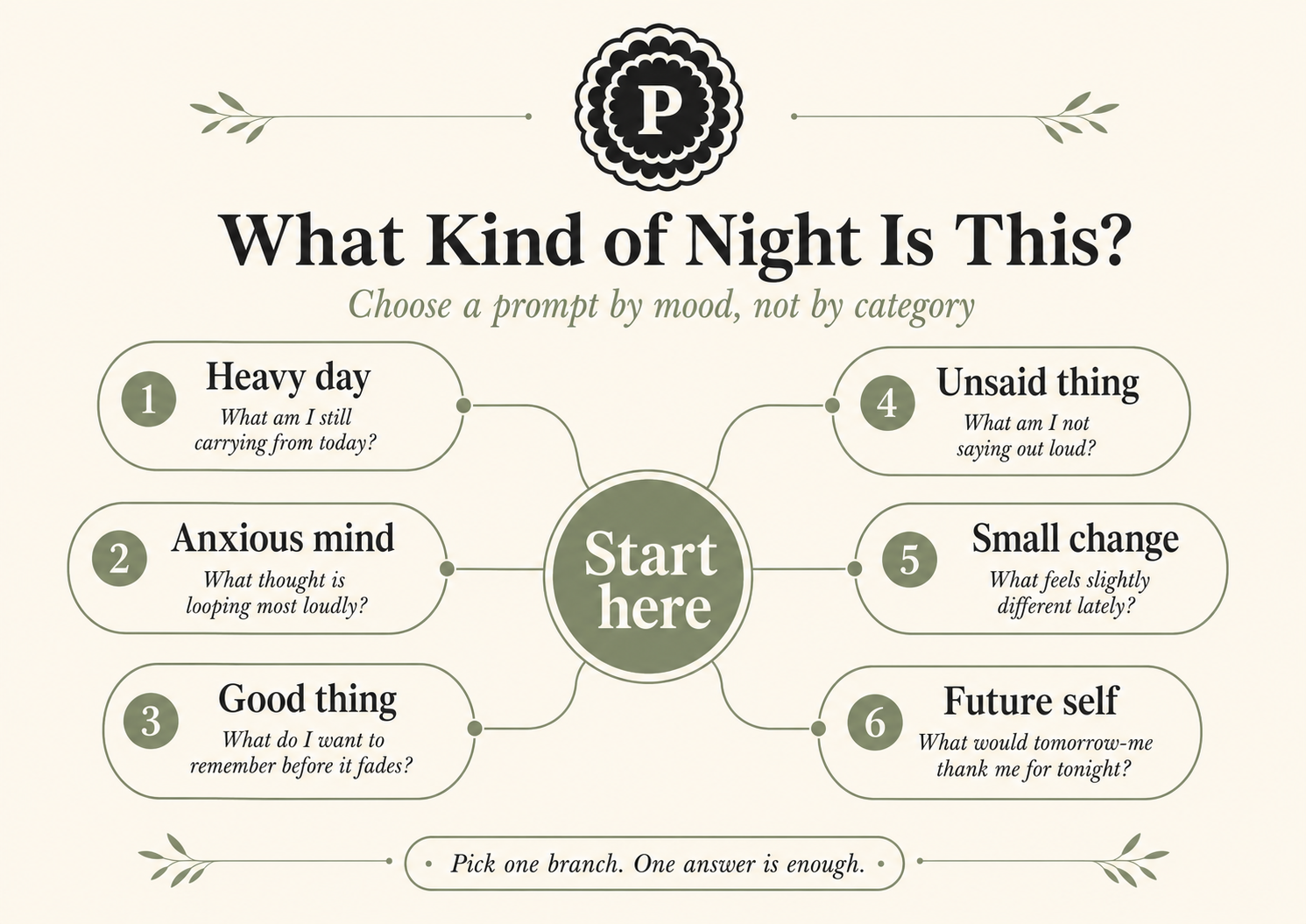
How to use any prompt in one minute.
There's no rule about pen or screen. The journal that gets written in beats the beautiful one that doesn't. Same goes for time of day, length, and tidiness.
Eighty journaling prompts, grouped by the moment.
When the day was heavier than expected
- What part of today carried weight that nobody saw?
- If I could name the heaviest moment, what was happening, who was there, and what was I trying not to feel?
- What did I tell myself today that I would never say to someone I love?
- Where in my body am I holding the day? Shoulders, jaw, chest, stomach?
- What's the smallest thing I could do in the next hour that would make tonight a little lighter?
- If today were a season, which one, and why that one?
- What got me through? Even just barely. Even just half-credit.
- What would I tell tomorrow-morning-me about tonight, if I knew she would read it?
When your mind won't quiet down at night
- What's the loudest thought right now? Write it down so it has somewhere to live besides your head.
- What am I afraid will happen if I stop turning this over?
- What am I afraid will happen if I do?
- If I gave this thought a name, what would I call it?
- What's a more boring version of the worst-case scenario I'm running?
- What would it mean to put this down until seven in the morning?
- What did I forget to feel today that's catching up with me now?
- Three things that are true in this room right now, that have nothing to do with what I'm worried about.
When you don't know what you're feeling
- If my mood were a weather forecast, what would today be?
- Where in my body do I notice something? A hum, a tightness, a hollow, anywhere.
- What did I almost cry at today, even if I didn't?
- What did I keep checking my phone for?
- If I had to pick between angry, sad, scared, and tired, which is closest? Or are two of them holding hands?
- What's the last thing I said that surprised me when it came out of my mouth?
- What conversation am I rehearsing in my head?
- If a friend described what they were feeling exactly like this, what would I think was going on?
When you're trying to be kinder to yourself
- What did I do well today that I'd notice immediately if someone else had done it?
- What am I being unfair about, where I'd give anyone else the benefit of the doubt?
- What did past-me figure out that I'm still relying on, without thanking her?
- What's one thing I've stopped giving myself credit for because it became routine?
- Where am I confusing high standards with self-punishment?
- What's the kindest thing anyone said about me recently that I dismissed too fast?
- If I were my own friend on the phone tonight, what would I say first?
- What's something I'm allowed to want that I haven't admitted to wanting yet?
When something good happened and you don't want to forget it
- What happened, in order, with the small details people forget to write down?
- Who was there, and what did they do that made it feel like this?
- What did I feel in my body when I realized it was going well?
- What did I almost not let myself enjoy, and why?
- How is the version of me that this happened to different from the one who was here last year?
- What did I do in the lead-up that I want to remember to do again?
- What's the thing I'd tell a younger version of myself about today?
- If this moment had a smell, a sound, and a temperature, what were they?
When there's something you cannot say out loud
- If no one would ever read this, what would I write?
- Who would I tell first, if I were allowed to tell anyone?
- What's the part I'm most afraid to admit, even to myself?
- What would change if I let this be true, even for the next five minutes?
- What does keeping this quiet cost me?
- What does saying it cost me?
- What's the version of this I could whisper, and the version I could only think?
- If I imagine setting this down on the page and leaving it there, what do I do next?
When you're starting again after a break
- What pulled me away from journaling, honestly?
- What was happening in my life the last time I wrote regularly?
- What did I miss about it, even when I wasn't doing it?
- What can I let go of about how I "should" journal?
- If I only wrote two sentences tonight and called it a comeback, what would they be?
- What part of my life has changed since I stopped, that I haven't processed on the page?
- What's the smallest possible commitment I could make right now and keep without resenting it?
- What would I tell someone else who'd taken six months off?
When you want to know yourself a little better
- What did I love at twelve that I quietly still love?
- What kind of conversations make me lose track of time?
- When I'm tired, what do I reach for? When I'm happy, what do I reach for?
- What do I notice that other people seem to miss?
- What story do I keep telling about myself that I'm not sure is still true?
- What value would I die on a hill for, that I've never written down?
- Whose life would I quietly hate, despite how good it looks from the outside?
- What kind of old person do I want to be?
When you're trying to be grateful without being saccharine
- What do I have right now that a version of me from five years ago would have begged for?
- What's the smallest, most boring thing today that I'd genuinely miss if it disappeared tomorrow?
- Who in my life would I be devastated to lose, that I have not told this week?
- What did my body do for me today that I didn't notice while it was doing it?
- What problem do I have right now that's only a problem because something else went well?
- What did someone do for me this week that I didn't fully clock at the time?
- If gratitude were not a feeling but a list of names, who's on the list tonight?
- What's one piece of luck I've been quietly taking credit for as hard work?
When you're trying to picture the next year
- If twelve months from now this year had been a good one, what would have been true about it?
- What's one small thing I could do this week that would make next year easier on me?
- What am I currently dragging into the next year that I could put down here, tonight, on this page?
- If my eighty-year-old self could sit across from me right now, what would she ask me to stop worrying about?
- What am I underestimating about myself for the year ahead?
- What am I overestimating, where I'm scaring myself more than the situation warrants?
- What's the version of next year I'm afraid to want out loud?
- What would I do tomorrow if I trusted that next year would work out, even partway?
How to use a prompt on Poplar tonight.
If you want a place that's built for exactly this kind of writing, here's the rhythm on Poplar. Pick a mood first. The app gives you six to choose from: Calm, Content, Fired up, Anxious, Low, Lost. Whichever one is closest is the right one. You're not committing to it for the night, you're naming the weather.
From there, pick any prompt above that matches the mood. Open the entry form on Poplar, type your answer, two sentences or twenty. Toggle the entry anonymous or signed, one Poplar at a time, so you can write one thing under your name and the next thing under nobody's. Submit. That's the whole loop on your side.
Then five strangers' entries land in front of you, one card at a time, written tonight to a prompt of their own. You read them. You can Root the ones that resonate, which is the gentler cousin of a like, a way of saving the lines that stuck. If you want the full walkthrough, how Poplar works covers the rest.
Morning or night, and why it matters less than you think.
One of the questions that comes up most often around daily journaling prompts is when, exactly, to use them. The honest answer is: whenever you're going to do it. Morning journaling and evening journaling do different things, but the practice that gets done beats the perfectly timed one that doesn't.
Morning, for spillover.
Whatever woke up with you, on the page, before the day claims the bandwidth. Coffee in one hand, prompt on the screen, ten minutes.
The questions that work here are the wide-open ones, the ones that don't require you to remember anything from yesterday. "What do I want to feel by the end of today?" "What's one thing I can do before noon that future-me will thank me for?" Good for clarity, less good for processing.
Night, for sorting.
The day already happened, and the brain wants somewhere to put it. The questions that work here are the specific ones, the ones tied to a moment that already passed. "What part of today carried weight that nobody saw?" Better for processing, better for sleep, less good for setting an intention you're going to act on in eight hours.
There's a mechanism underneath this. In an fMRI study by psychologist Matthew Lieberman, putting feelings into words reduced activity in the amygdala, the brain's alarm system, while the more deliberate prefrontal cortex took over the work. Thirty people labeling images in a scanner is a mechanism, not a treatment. But it's a fair description of what a specific question does at midnight.
Morning
- For spillover, before the day claims the bandwidth
- Wide-open questions
- Good for clarity
- Less good for processing
Night
- For sorting the day that already happened
- Specific questions tied to a moment
- Better for processing and sleep
- Less good for setting an intention
Most of the people who keep a journal for years do one or the other, not both. Some do both, but they're usually the people who've been at it for a decade.
Start with the one that fits the slot in your day where you already pause. If that slot is bed, write at night. If it's coffee, write in the morning. The rhythm matters more than the clock.
If the prompts stop landing.
This happens. You'll go through a stretch where every prompt feels stale, or you'll notice you're answering the same prompt the same way three nights running, or you'll feel worse after writing instead of lighter. None of this means the practice is broken. It usually means one of three things.
There's a name for the difference. Psychologists Paul Trapnell and Jennifer Campbell, studying why looking inward helps some people and sinks others, found that self-attention splits into two motivationally distinct dispositions: rumination, driven by threat, and reflection, driven by curiosity. Same pen, same page. What differs is the question you keep asking.
The journal has become a place to repeat the loop rather than break it. That loop has a research record: Susan Nolen-Hoeksema's work on rumination found it predicts the onset of depression more consistently than it predicts how long one lasts, partly because it crowds out actual problem-solving.
The fix isn't to stop writing. The fix is to switch the prompt category. If you've been in the "mind won't quiet down" section for a week, move to "kinder to yourself," or "knowing yourself a little better," or "good thing you don't want to forget." Different question, different muscle. Our notes on journaling for anxiety go deeper on this loop.
Drop the depth. Use a shallow prompt for a week. "What did I eat today?" "What made me laugh?" "What was the weather like?" Boring entries are still entries. The streak isn't the point, but the rhythm is.
It's a conversation with a person, or a therapist, or a doctor. The journal will sit there when you come back. It's not going anywhere.
One small practice for making this stick.
Don't try to write daily on day one. The people who keep a journal for years almost never started by promising themselves a year. They started by promising themselves three days.
Try this. Pick three nights in a row. On each one, pick a single prompt from one of the sections above, set a timer for five minutes, and answer it. If the timer runs out mid-sentence, you stop. If you blanked the whole time and wrote one line, you stop. You did the thing.
Short entries are almost always better than skipping a night. The thing you write in two minutes about why you don't want to write is still the practice.
After three nights, try seven. The "not today" entry counts as one of the seven. Write "not today, but here's why" and call it done. The streak isn't the point. The point is that the journal becomes a place you go, instead of a thing you mean to do.
For the longer version of this, our piece on how to journal daily walks through the rhythm without the guilt-trip energy.
Where to write them down.
Paper works. So does the notes app. So does any app you already have that lets you type without anyone watching. The format matters less than the rhythm.
The version that writes back.
If you want a quiet place to write where the prompts come to you instead of the other way around, Poplar is one place to start. It's an anonymous diary that hands you a rotating set of these kinds of questions and lets you write a few sentences, or a few pages, without anyone knowing it's you.
Other people are writing at the same time, anonymously too, and you can see a few of their entries after you post yours. The whole thing is built for the kind of writing you only do when nobody's watching.
If you want to go further in that direction, our note on journaling for self-reflection is a sibling to this one.
Frequently asked questions.
What are good journal prompts?+
A good prompt does one thing: it lowers the cost of starting. The questions you'll go back to tend to share three traits.
They're specific (not "how was today" but "what was the heaviest moment of today"). They give you permission to feel something less-than-pretty. And they don't require a tidy answer. If a prompt makes you want to put the pen down, that's information about where you are tonight, not about the prompt.
What is the 3-2-1 method of journaling?+
Three things you learned today, two things you enjoyed, one thing you'll focus on tomorrow. It's a clean structure for evening reflection, and it works because it asks you to notice instead of analyze. Useful when you're tired and want a low-effort version of the practice.
What is the 3-3-3 journal method?+
A variant that swaps in three things you're grateful for, three intentions for tomorrow, and three affirmations. Some people find it warmer than 3-2-1; others find it slightly performative. Try both for a week. Keep whichever leaves you feeling more like yourself.
Is there a "dark side" to journaling?+
Yes, and it's worth knowing. If journaling becomes the place you rehearse the same hurt every day without any movement, it can deepen rumination instead of relieving it.
The fix isn't to stop writing. It's to vary the prompts. Move from "what's wrong" to "what's true right now," "what did I do well today," or "what would I say to a friend in this situation." If writing consistently leaves you feeling worse, a therapist or counselor can help in a way a page cannot.
How often should I journal?+
As often as it helps. Daily works for some people. The anxiety trial described earlier in this post used fifteen minutes three days a week, which is a reasonable floor if you want a rhythm with evidence behind it.
Once is better than never. The frequency question matters less than whether you can keep the practice alive when life gets noisy, which is why short entries are almost always better than skipping a night.
Can journaling prompts replace therapy?+
No. Journaling is a tool for noticing, not a replacement for someone trained to help you process. If you're working through grief, trauma, depression, or anything that feels too big to hold alone, a therapist is the better fit. Journaling can sit alongside that work and make sessions more useful, because by the time you arrive you already know what's on your mind.
When is the best time of day to use journaling prompts?+
Whenever you'll do it. Morning prompts work well for setting intention and clearing spillover from sleep. Night prompts work well for processing what already happened and slowing the mind down before bed. If you're choosing between the two, pick the one that lands in a slot where you already pause. The rhythm matters more than the hour.
How long should a journal entry be?+
Long enough to answer the question, short enough that you'll come back tomorrow. Two sentences is a real entry. Two pages is also a real entry.
People who keep the practice for years tend to write short on most nights and long on a few, not the other way around. If you're feeling pressure to fill a page, that pressure is the problem, not your entry.
What do I do when every prompt feels stale?+
Switch categories. If you've been answering questions about feelings for a week, move to questions about memory or curiosity. If you've been writing serious entries, write a boring one. Stale prompts are usually a sign that one part of your life is over-represented on the page and another part is under-represented. The fix is variety, not effort.
Are journaling prompts better on paper or in an app?+
Whichever one you'll keep open. Paper is good for slowness and for not being on a screen at midnight. Apps are good for searchability, privacy, and writing in places you wouldn't carry a notebook. Most people who've kept a journal for a long time have used both at different times. The format that gets written in beats the one with the better cover.
Can I use the same journaling prompt every night?+
You can, and there's a version of the practice that's built on exactly this. Three or four steady questions, answered every night, become a record of how you changed over time. The risk is that the answers go on autopilot. The fix is to mix in one new question a week so the steady ones stay honest.
One last thing.
You don't have to do all eighty. Pick one tonight. The one that lands. Or scroll to a moment you're not in right now, and bookmark it for when you are.
The blank page is the hardest part. Then you start, and it isn't anymore.