
How to journal anonymously online (without writing into a void)
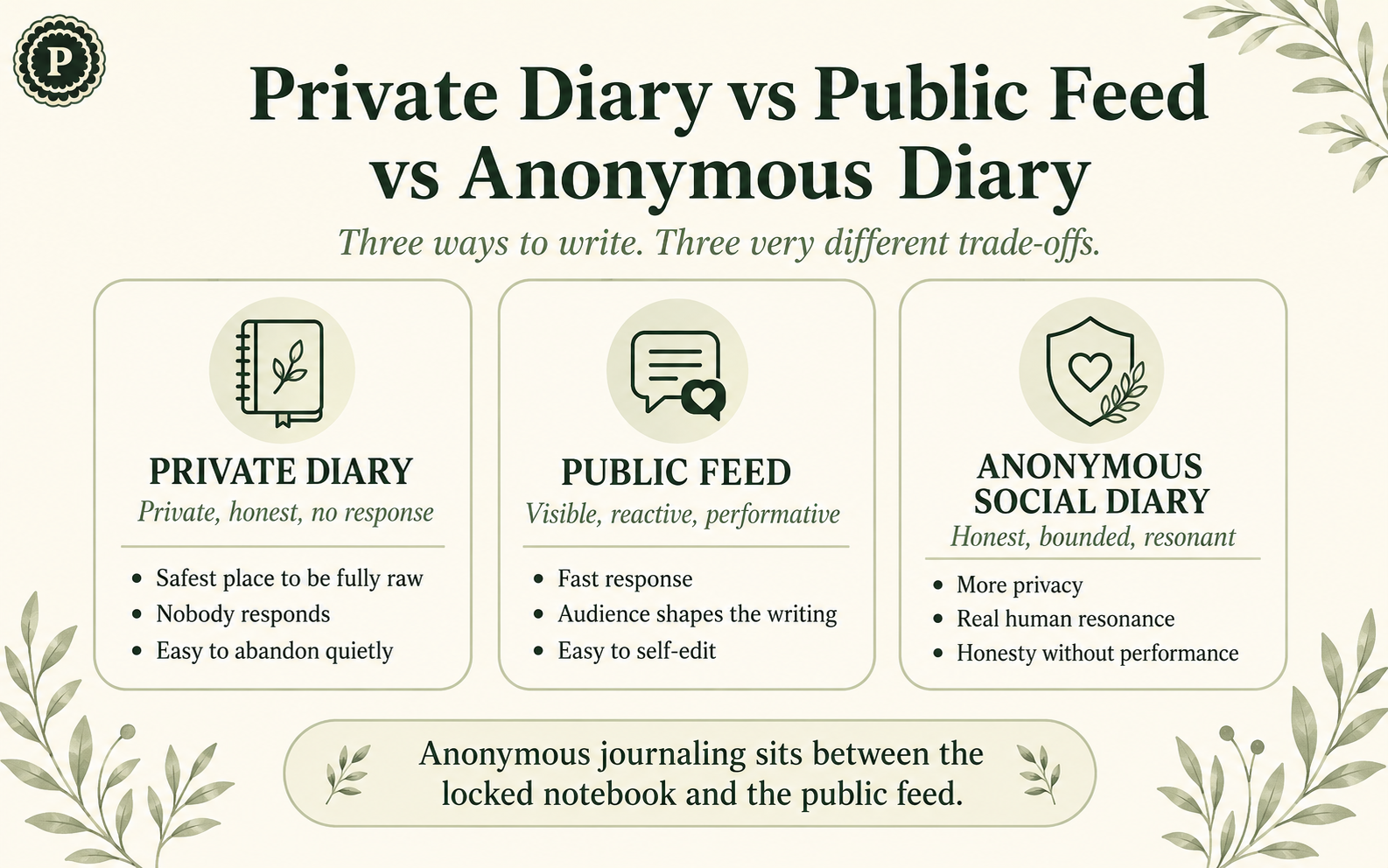
Anonymous online journaling sits between the locked notebook nobody reads and the feed that warps your voice. Here's how to set it up so it actually sticks.


Key takeaways
- Anonymity isn't the absence of readers — it's the absence of consequence from readers. That distinction is the whole point.
- Per-entry anonymity lets you write today's hard entry unsigned and sign tomorrow's proud one from the same account. No "now you are public" switch.
- Three account hygiene rules that matter most: skip tools that ask for a phone number, check default visibility before your first real entry, and don't trust browser-only storage.
- The locked notebook solves privacy but creates loneliness. A good anonymous social diary solves both at once.
- A 7-day starter keeps the barrier low: one prompt category, one anonymous entry per session, read what comes back before writing again.
Two fears, one middle ground.
There are two fears that keep people from writing honestly. The first is being read by the wrong person. The second is writing into nothing. Most "private journal" advice solves one and ignores the other.
You either lock everything down so well no human eye ever lands on a sentence you wrote, or you publish to a feed that hands your words to your boss, your ex, and a stranger trying to sell you a course. Anonymous online journaling sits in the middle, and the middle is where the practice holds up.
This is a guide to setting up that middle ground without it falling apart in a week. Some of it is account hygiene. Most of it is understanding what anonymity gives you, what it doesn't, and how to write under it without writing into a void.
Why most "private journals" are halfway solutions.
The notes app feels private until you remember it's syncing to iCloud and you once shared an iPad with someone. Paper sits in a drawer, which is fine, until you move, or someone helpful decides to tidy your desk.
Day One and the paid journaling apps are well-built, but they assume every entry is signed under your name. For anyone navigating a transition, processing something complicated, or trying to write the unflattering thing, signing everything under your own name is the friction that quietly kills the habit.
Then there are the social-media-shaped "journals." You post a thought, the post lives on a timeline with your face attached, an algorithm decides who sees it, and you slowly start writing for whoever you think might be reading. The void disappears, but so does the honesty. A diary without likes is the version that doesn't warp your voice that way.
Anonymity isn't the absence of readers. It's the absence of consequence from readers. That's the distinction that matters.
What anonymity gives you that a locked notebook can't.
A locked notebook is good for one thing: nobody reads it. That is also its limitation.
When James Pennebaker ran the first expressive-writing experiment in 1986, students who wrote about their most traumatic experiences for fifteen minutes a day, four days in a row, made fewer visits to the health center in the months that followed than students who wrote about surface topics.
Writing about hard things helps, whether or not anyone reads the result. That is where most journaling advice stops.
And the line still misses something: how much harder it is to keep writing when you know nothing you write will ever be witnessed.
The reader without the strings.
Anonymous online journaling gives you the eyes you want, just without the strings. A stranger reads the entry. They don't know your name. They can't message your work account. They can't screenshot it into a group chat with friends who recognize you.
The reader is real and the consequence is not, and that combination is what gets people writing the things they wouldn't write in a notebook nobody opens. Adam Joinson measured the same pattern in the lab: across three studies of online conversation, people who were visually anonymous disclosed significantly more about themselves than people who could be seen.
Psychology has a name for this loosening. John Suler called it the online disinhibition effect: six factors that make people self-disclose, or act out, more frequently and intensely online than in person, with dissociative anonymity first among them.
What you get back.
It also gives you the gift of reciprocity. You read other people's entries written under the same protection. You learn that what you assumed was a uniquely embarrassing thing to feel is a Tuesday for half of your invisible cohort. That's not a feature you can build into a Moleskine.
How to set up anonymous journaling that won't ghost itself in a week.
Most anonymous-journaling setups fail for boring reasons. Account hygiene gives up. The "private" tool turns out to share by default. Someone picks a passphrase, forgets it, stops writing. A short checklist:
Pick something you'd be fine with a stranger reading. Your initials are still you. A handle from an old game account works better.
A passphrase-protected notebook still has your iCloud or Google account behind it. If you want full separation, make a new email and use it for the journal only. Most people don't need this. Some sleep better with it.
Phone numbers are identity-linkage glue. If a "private journal" wants one, find a different one.
Some tools default to public, some to private, some have a setting buried in preferences. Write a throwaway first entry, see where it ends up, then start the real practice.
"Stays in your browser" sounds great until you clear cookies. Treat local-only tools as scratchpads.
Three times a week beats every day in week one and zero by week three. How to journal daily without making it a chore covers cadence in more detail.
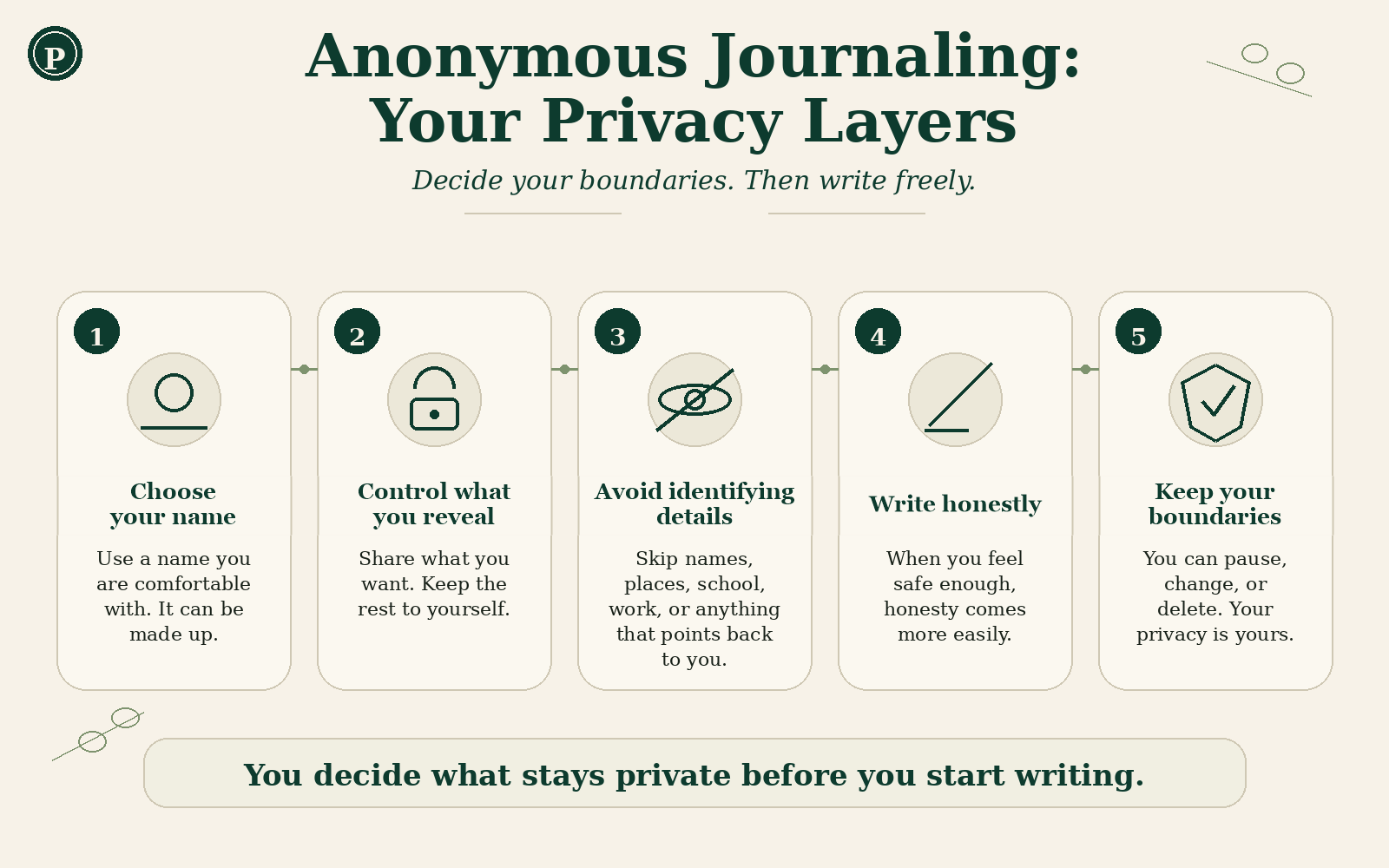
Setup is the boring part. It's also the part that decides whether you're still writing in a month.
Where Poplar fits.
Poplar is a small diary app, made by one developer, built around the middle ground this post is about. The core mechanic is simple. You write one entry. Five entries from other people come back to you in return. No feed. No follower count. No likes visible to anyone reading.
The part that matters here is the anonymity toggle. Anonymity on Poplar is per entry, not per account. Today's entry can be anonymous, tomorrow's signed, the day after anonymous again. Same account, both modes. Anonymous entries appear as "Anonymous" with no link back to your profile. Signed entries link to your username and join the small, quiet identity you build over time.
The default for your first entry leans anonymous, on purpose. The first entry is the one most people are most nervous about. How Poplar works walks through the rest of the mechanics, but the toggle is the thing to remember: signing your name today does not commit you to signing tomorrow.
The same diary can hold the unflattering Tuesday and the signed birthday reflection, and neither one collapses into the other.
Reading anonymous entries from other people.
Reading is half the practice. Anonymous journaling as a write-only thing eventually feels like the locked-notebook problem in a new costume. When you also read what other people sent into the same middle ground, two things happen.
The first is permission. You see what other people will put on the page under the same protection you have, and your sense of what's "too much" recalibrates. The lab agrees: in John Bargh's experiments, strangers paired over the Internet were better able to express their true-self qualities to each other than strangers meeting face to face.
The second is company. Not friendship, not community, just the awareness that the entry you're about to write isn't the only one of its kind being written tonight. Benefits of a social diary goes into the full case.
When to sign your name.
Anonymity is the default for a reason, but it's not the whole picture. Some entries are worth signing.
Birthdays, gratitudes, the entry where you finally got the thing you'd been working toward, the one where you want the version of yourself reading this in three years to recognize who wrote it. Signed entries build a slow record of you that anonymous ones can't.
The point of the per-entry toggle is that you don't have to decide between a fully anonymous identity and a fully named one. You can have both, on the same account, in whatever ratio fits the week.
A 7-day starter.
If you've never journaled anonymously online, the first week decides whether you keep going. Keep it small.
The point of the seven days is finding out whether the middle ground works for you. If it does, the practice keeps itself going. How to start journaling covers the longer arc.
Frequently asked questions.
Is journaling online anonymously truly private?+
Privacy and anonymity are different things. Privacy is whether anyone can see your entries. Anonymity is whether they can tie what they see to you specifically. A good anonymous journal handles both: entries are visible to other readers, with no name attached and no way to reverse the connection back to your profile. Check the privacy page of whatever tool you use.
Will other Poplar users see my real name if I post anonymously?+
No. Anonymous entries appear as "Anonymous" with no link back to your profile. Readers see the entry text, the doodle if you added one, the mood, the tags. They don't see your username, your email, or anything that connects the entry to a profile they could visit.
Can someone match my anonymous entries back to my profile?+
Not from the reader side. There's no profile link on an anonymous entry, no breadcrumb in the interface, no way to click through to "see other entries by this author." If you also post the same content under your name, you're doing the matching yourself, which is a different problem.
Can I delete my anonymous entries later?+
Yes. Anonymity doesn't change deletion. You can delete an entry whether you wrote it anonymously or signed.
Do I have to give a real email when I sign up?+
Signup is email or Google. The email doesn't have to be your main one. There's no real-name verification, no phone number requirement, no social account link.
What if I want to start signing my entries later?+
You can. The per-entry toggle means you decide each time. There's no "now you are public" switch that retroactively reveals old anonymous entries. They stay anonymous. New ones can be signed.
Is journaling anonymously the same as journaling alone?+
No, and that's the point. The locked notebook is alone. Anonymous online journaling has readers, just readers who can't act on what they read. The presence of a reader changes the writing. The absence of consequence keeps it honest.
Are there other anonymous journal apps?+
Yes. Private-only notepads, browser-based diaries, community boards with anonymous posting, and a handful of mobile-only options. Some are write-only with no reading. Some are public-board-shaped with anonymous handles. Poplar is the one built around the daily one-for-five exchange with per-entry anonymity. Pick the shape that fits how you want to write.
One last thing.
Want to try the middle ground? Sign up for Poplar. Your first entry is anonymous by default, and five entries from other people come back the next day.