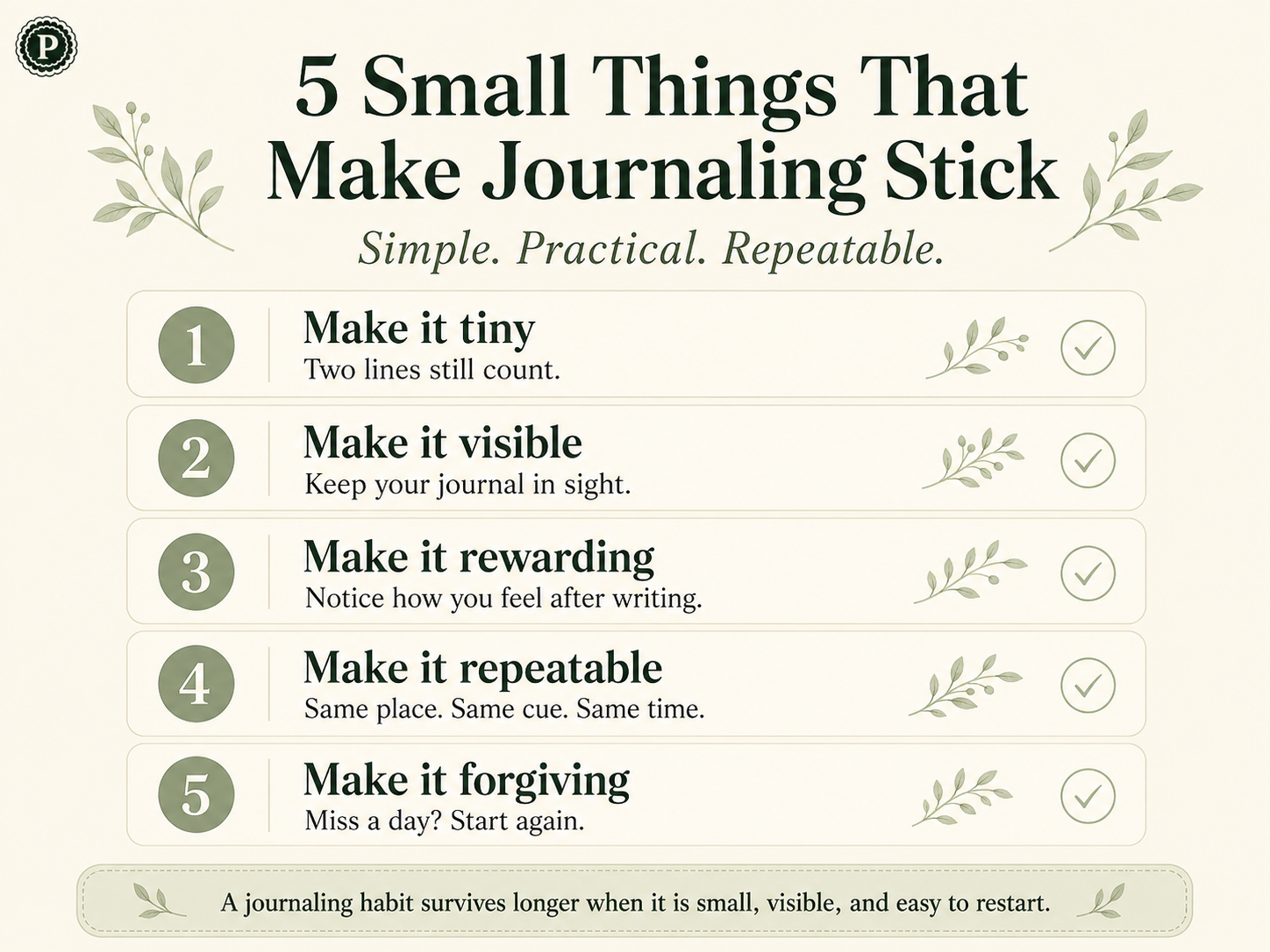
5 small things that make journaling stick
Most journals die in week three. The reason isn't motivation. It's the absence of feedback loops. Here are the five small things that close them.


Key takeaways
- Journals don't die from lack of motivation — they die because nothing happens after you write. The void is the real enemy.
- A quiet anonymous reader closes the feedback loop without corrupting your voice the way a public audience would.
- Roots build a private archive of entries that mattered — yours and others' — making the practice searchable over time.
- A streak with two weekly forgiveness freezes survives real life; without them, one missed day becomes a reason to quit entirely.
- Full Bloom (three entries in a day) is a marker for good days, not a target — that distinction is what makes it work.
Why journals die in week three.
Most journals die in week three. Not week one, when the novelty carries you, and not week two, when the early streak is still in front of you. Week three is when the practice has stopped feeling new but hasn't yet started feeling like part of the day.
There's a reason it happens exactly there. When psychologist Phillippa Lally and her colleagues tracked ninety-six people repeating a new daily behavior, the feeling of automaticity plateaued after an average of sixty-six days, and individual times ranged from eighteen days to the better part of a year.
Sixty-six days to a habit, on average. Week three is barely a third of the way there.
Three weeks in, you are nowhere near the plateau. The habit hasn't failed. It just isn't one yet.
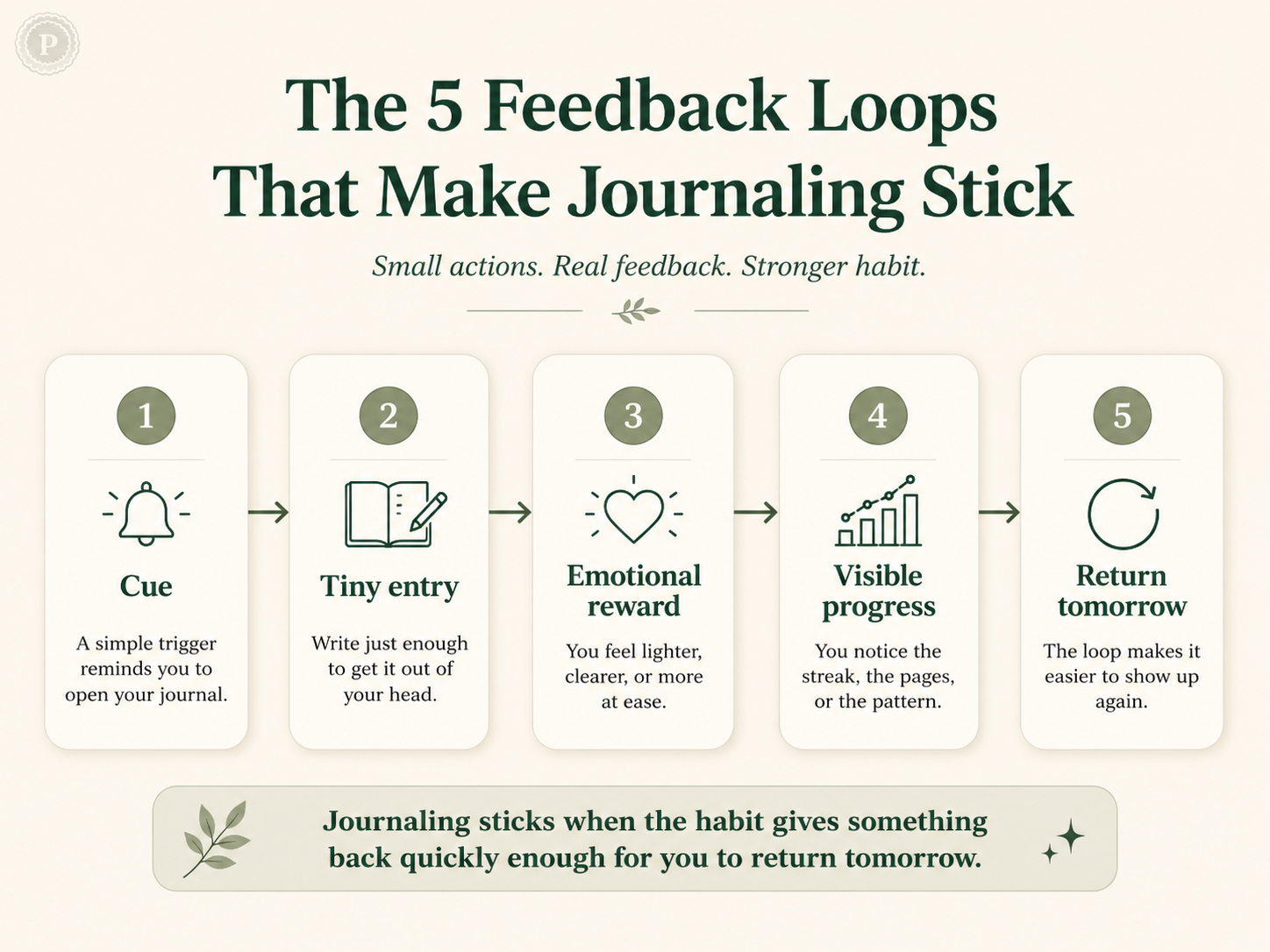
And the honest reason it dies is almost never "I wasn't motivated enough." It's that nothing happened after you wrote. No reader, no record of what landed, no scoreboard you trusted, no quiet sign that the day went well. The practice was an open loop, and open loops close themselves.
This is a guide to the small things that close the loop. There are five. None of them are about willpower. Each one is the answer to a specific failure mode that kills journals in the third week.
One: someone reads it.
The first failure mode is the void. You write a thoughtful entry, close the notebook, nothing happens. The whole pitch of journaling is that it's for you. But the brain isn't built to keep doing things that produce no signal they were done. After a few weeks of writing into the void, the practice starts feeling like a chore, and then it stops.
The fix isn't an audience. An audience makes you write for whoever you imagine might be reading, and your voice goes corporate inside a week. The fix is a quiet reader. One stranger who reads an entry of yours once or twice a week and never tells you anything about themselves. They were just there. That's enough to close the loop.
On Poplar, this happens through a swap. You write one entry, a small handful of entries from other anonymous diarists come back. No likes, no follower counts, no comment threads. A diary without likes covers why that matters.
Your entry was read, and that's the entire feedback signal.
Two: a way to save what landed.
The second failure mode is one most people don't name. You read an entry that says the thing you've been circling for a month, and you think, "I'll remember that." You don't. Six weeks later you have a vague memory the entry existed and no way to find it.
The fix is a place to save what landed. Not a public favorite. A private bookmark, for you, of the entry that mattered. On Poplar these are called Roots. You can root your own entry, or one from another anonymous writer. The writer sees a quiet count, not a name.
Three months in, you can scroll your Roots and find the entry from late February where you finally said the thing about your job out loud. The journal becomes searchable in the way only the things that mattered are searchable. Journaling for self-reflection is mostly about this compounding effect. Roots make it visible.
Three: a way to write back.
The third failure mode is the comment box. You read an entry that matters to you, and you have nothing to add inside a one-line reply. So you don't reply. The connection that almost happened just doesn't. Over months, this is the loop that turns "social diary" into "feed I scroll past."
The fix is to give people a way to write back that's the same shape as the original. Not a comment. An entry. On Poplar these are called Echoes. You read an anonymous entry, you have a real reaction, and you write an Echo: a full entry of your own, branching off the original. It's not a thread. It's a tree.
The 3-per-day cap is what keeps it working. Without a cap, Echoes would be a comments section with longer comments. With a cap, you have to pick the entries you really have something to say to. You read more carefully because you only have three. The constraint is the feature.
Four: a gentle scoreboard you can't lose.
The fourth failure mode is the streak rage-quit. You build a 23-day streak. You miss a day. The 23 collapses to zero. You feel stupid, then resentful, then you stop opening the app. The all-or-nothing collapse is what drives the long-term churn, not the streak itself.
The fix is forgiveness mechanics built into the streak. On Poplar, two freezes a week are banked automatically. If you miss a day, the freeze is consumed silently. Your streak survives. No guilt-trip notification. No Duo the owl with sad eyes. The missed day is absorbed and the streak keeps going.
That's a streak system designed to match how a journaling habit really works, where some weeks have a Tuesday that just doesn't have an entry in it.
There are also two streak counts: current and longest. The longest streak is a permanent record. It doesn't reset when the current one does. Neither number is on a public leaderboard, because there is no public leaderboard.
A scoreboard you can't lose is a scoreboard that's still there in month six. Every other kind of streak system loses you in week four.
If you've quit a journaling app because the streak collapsed and the next time you opened it the zero felt like a permanent statement about you, the freeze is what was missing. How to journal daily covers the cadence question more directly.
Five: a quiet reward when you have a great day.
The fifth failure mode is the absence of any signal that a day went well. Most journaling apps treat every day the same, which is technically correct and emotionally flat.
Some days you write one entry to clear the air. Some days you write three because the day genuinely had three things in it. There's no marker for the second kind, so it stops standing out.
On Poplar, three entries in a calendar day earns a Full Bloom badge: an amber-colored mark on your profile for that day. No points. No levels. Not on a leaderboard. A small acknowledgment that the day was that kind of day.
It works as a habit mechanism because it answers a question most journaling apps leave open: what does a "good day" look like in the practice? On Poplar, a good day looks like three entries.
What's not on this list.
A few things every other journaling-habit guide includes that aren't here, on purpose.
| Common advice | Why it's not here |
|---|---|
| Community size | Bigger isn't the answer. Diaries fall apart at 100k users because they become feeds. |
| Daily prompts pushed at you | A prompt list you can pull from is useful. A push notification telling you what to write turns the practice into a homework assignment. Journaling prompts exist on Poplar as something you pull from, not something pushed at you. |
| AI summaries of your entries | An algorithm telling you what your week was about is the inverse of journaling. The point is to do the noticing yourself. |
| Public engagement metrics | Likes, follower counts, view counts, trending entries: all the things that turn a diary into a feed. None are on Poplar, for the same reason none are on your paper notebook. |
The order to try them.
Don't bolt all five on at once. They compound in an order.
Before any of them, decide when the writing happens. When psychologists Peter Gollwitzer and Paschal Sheeran pooled ninety-four tests of if-then planning, spelling out in advance "if it's nine o'clock, then I open the diary" had a medium-to-large effect on goal attainment compared with good intentions alone. Vague resolve is the first thing week three eats.
Anchor the writing to something you already do, too. In an exploratory study, Gaby Judah and colleagues asked fifty adults to floss daily; the ones told to floss right after brushing, rather than before, tended to form stronger habits at eight months.
The tail end of an existing routine is the most reliable hook for a new one. Kettle on, diary open.
How Poplar works walks through all five mechanics in one place.
Frequently asked questions.
Why do I always quit journaling after a month?+
Almost always it's the void. The brain stops doing things that produce no signal, no matter how much you believe in the practice intellectually. Fixing the void with a quiet reader is the single biggest change you can make.
Are streaks a good thing for journaling?+
Streaks help you keep a habit going through the boring middle weeks. They turn destructive the moment a single miss erases everything. A streak system with forgiveness mechanics gives you the motivation without the rage-quit risk.
How does Poplar's streak system handle bad days?+
Two freezes per week are banked automatically. If you miss a day, a freeze is consumed silently and your streak continues. No guilt notification, no big red zero. Your longest streak is a permanent record that doesn't reset when the current one does.
What is the most overrated journaling habit advice?+
"Just write five minutes a day." It's not wrong, it's incomplete. Five minutes a day into a void is what makes people quit. Five minutes a day where someone reads it and you have a small archive of what landed is a different practice, even though the writing part looks identical.
Should I read other people's diaries to stay motivated?+
Reading is half the practice. The point isn't motivation. It's reciprocity. You read entries from anonymous writers under the same protection you have, and your sense of what's "too much to write down" recalibrates. Benefits of a social diary covers the longer version.
Is the 3-entries-a-day cap on Poplar limiting?+
You can write as many entries as you want. The cap is specifically on Echoes, the reply-as-entry mechanic. It keeps Echoes feeling like real entries instead of a comments section.
How is Full Bloom different from a typical achievement badge?+
It's not a target you're expected to hit. It's a marker for the days it happens. No levels, no rare variants, no Full Bloom streaks to chase. Targets are another thing to fail at. Markers are something to notice.
What if I miss two weeks?+
You come back. The streak resets, but the diary, the Roots, the Echoes, and the Full Bloom days from before are all still there. The practice picks up where it left off. How to start journaling is more useful than you'd expect when "start" is really a restart.
One last thing.
If you've quit journaling more than once and you're wondering what was missing, the answer is almost certainly on this list. Pick one, not all five. Benjamin Gardner, Phillippa Lally, and Jane Wardle, the researchers behind the sixty-six-day finding, wrote advice for general practitioners recommending exactly this shape: small, context-anchored daily actions, not sweeping overhauls.
The point isn't to optimize the practice. It's to close the loop so the practice can hold. Try it tonight at poplardiary.com.