
How to journal daily without making it a chore
A practical guide for people who want to make journaling daily, not just occasional. A five-minute template, streak rules that survive real life, and twelve prompts for the nothing days.


Key takeaways
- Daily journals die from three predictable causes: performance pressure, broken-streak rage-quit, and writing into a void with no feedback loop
- Poplar's hard cap of three entries per day is a feature — it prevents overperforming in good weeks and protects the practice from itself
- Two streak freezes per week are banked automatically, so a sick night or red-eye flight doesn't end months of consistency
- On thin days, sending two or three Echoes counts as a writing day — the muscle you're protecting is showing up, not generating original material every night
- Five minutes is a complete entry on a bad day; the template covers mood, one sentence about today, one body check, and one outward observation
There's a difference between wanting to be someone who journals daily and being one.
If you've started journaling more than once, you already know the pattern. The first week is easy. The second week is fine. The third week is when life gets noisy and the entry gets shorter, then shorter, then skipped. By the end of the month, you've stopped, and a small part of you feels like you failed at a thing that was supposed to be easy.
It's not that you failed. It's that the version of the practice you tried to build was unsustainable on a bad Tuesday. Daily journaling that lasts a year doesn't look like daily journaling that lasts a week. It's smaller, sloppier, less ceremonial, and more forgiving. And the tools you use either help that or quietly sabotage it.
The journaling that lasts a year is smaller, sloppier, and less ceremonial than the journaling that lasts a week. Build for the bad Tuesday, not the inspired Sunday.
What follows is the boring version of how to journal daily, built around the way Poplar is designed for it.
A cap of three entries per day so you can't perform. Streaks with two freezes a week so a sick night doesn't end the practice. Echoes for the days you don't have a fresh entry in you. And a five-minute template that gets you from open app to closed app without ceremony.
Why most daily journals die.
Three reasons, and they're almost always the same three.
You start writing because you read that journaling is good for you, and somewhere in the back of your head you're writing for a future reader. The entries get longer than they need to be, more polished than they need to be, and after a week you're tired. You aren't tired of journaling. You're tired of performing it.
A Duolingo-style streak counter feels great on day fourteen and feels awful on day fifteen when you missed Wednesday because you fell asleep at 9pm. The number resets, the gain feels lost, and the notebook goes in a drawer. The streak didn't break the practice. The brittleness of the streak broke the practice.
You're writing into a void. Nothing comes back. After a month of pouring small honest sentences into a black box, the brain quietly stops wanting to.
The structural fix isn't more discipline. It's a writing surface that takes those three failure modes off the table on purpose.
The cap of three entries per day is the secret.
Poplar lets you post a maximum of three entries in a day. Not a goal. A ceiling. The first time you hit it, it feels like a limitation. After a month, you realize it's the most important rule.
Here's the counterintuitive part. The cap protects the practice from you. Without a ceiling, ambitious weeks become five-entry days, then six-entry days, then you crash on day eleven because nobody can sustain that. With the ceiling, a "good" day is one or two entries. A great day is three. There's no "more" to chase, so the chase never starts.
The same logic shows up in writing communities, gyms, and meditation apps. Scarcity protects consistency. When the upper bound is low, the floor stops being scary. Two sentences before bed becomes a real entry instead of a guilty placeholder, because two sentences is one third of your daily ceiling, not a fraction of an imagined ideal.
Most daily-journaling advice tells you to write more. The honest advice is to cap how much you can write, so the days when you don't feel like writing don't feel like a failure compared to the days you wrote three pages.
Without a ceiling, ambitious weeks become five-entry days, then six-entry days, then a crash on day eleven. With a ceiling, "good" is one entry. "Great" is three. The chase never starts.
A daily-Poplar template.
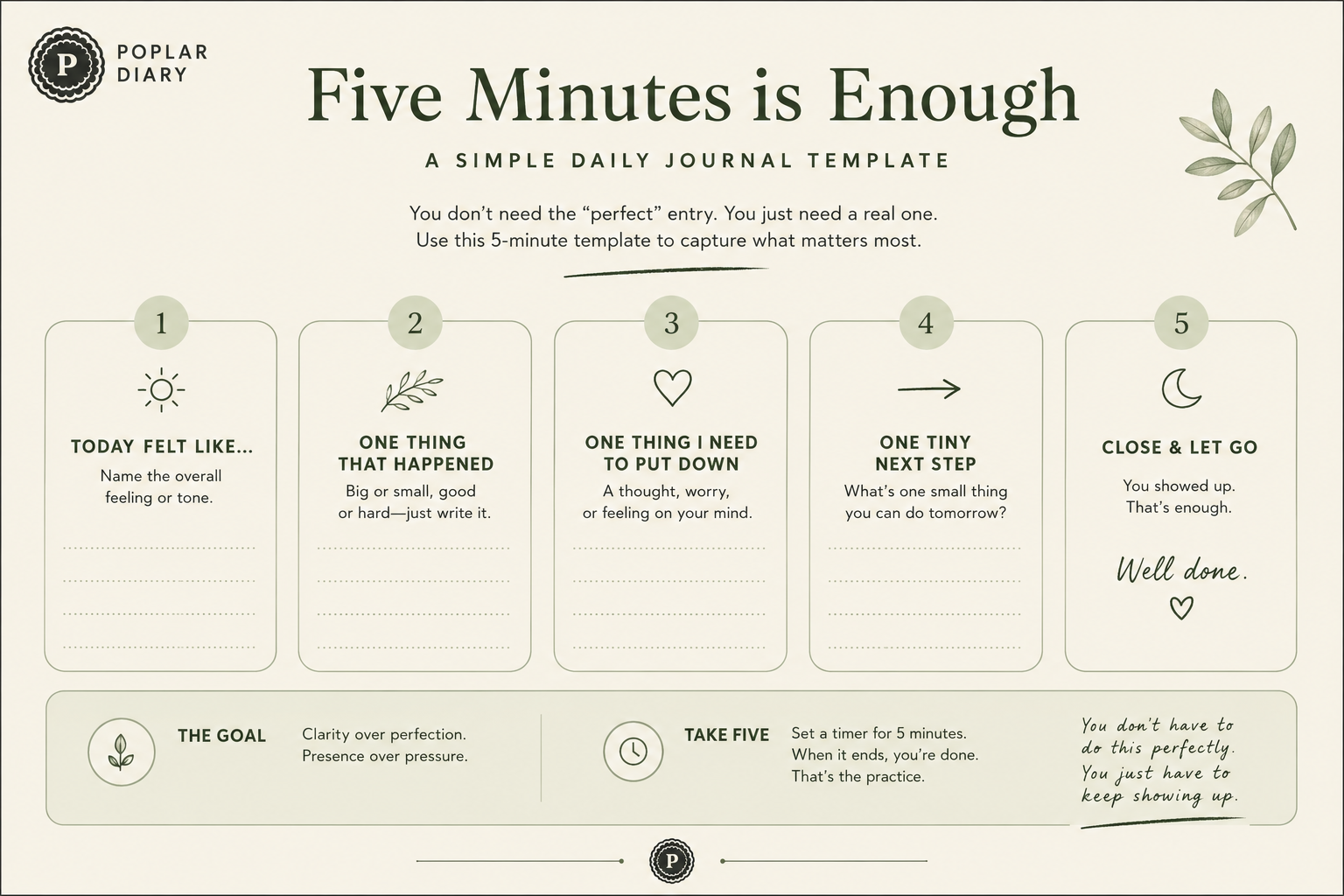
The single most useful thing you can do for daily consistency is build a template you can run in five minutes on a bad day. The template doesn't replace longer entries on good days. It guarantees there's an entry on the days you'd otherwise skip.
The flow inside Poplar is short enough to memorize: open the app, pick a mood, write a few sentences, submit anonymously, read what came back. Five minutes is real, not aspirational. The template below maps onto that flow.
That's five minutes. That's a complete entry. On a bad night you'll do three of the five steps and call it done. On a good night you'll write three pages from the second prompt and never get to the fourth. Both count toward the day, and the day is what compounds.
If you want a fuller picture of how a Poplar entry flows from draft to feed, the how Poplar works guide walks through it. If you want more prompts than the template can hold, the journaling prompts guide is the place.
Streaks without the guilt.
Streaks are a useful psychological tool. They are also the fastest way to ruin a daily habit when the tool gets sharper than the practice.
Poplar shows you two numbers: your current streak and your longest. Both are private to you. Nobody else sees the count, so there's nothing to perform. The streak is feedback, not a leaderboard.
The part that matters most is the freezes. You get two streak freezes per week, banked automatically. If you miss a day, a freeze gets consumed and the streak keeps going. You don't have to remember to use it. You don't have to ask for it. It just absorbs the miss.
This is the design choice that does the heaviest lifting. Duolingo-style streaks are anxious because one miss erases everything. Two freezes a week means the practice can survive a sick night, a red-eye flight, a fight with your partner, a Wednesday where you just forgot.
The number on the counter stops being something you protect anxiously and starts being something you check occasionally, the way you'd check a step counter. The practice is the thing. The count is decoration.
The streak is a tool for keeping the practice alive. The moment it becomes the thing you're protecting at the expense of the practice itself, drop it. The habit matters. The number is decoration.
What to do when you miss a day.
You will miss a day. Probably this month. This is the moment the practice ends for most people, and it almost never ends because of the missed day. It ends because of the story you tell yourself about it.
The story usually goes: I broke the streak, I'm not the kind of person who follows through, I'll start fresh next Monday. By Tuesday, "start fresh next Monday" has become "next month." By next month, the diary is closed. The missed day didn't end the practice. The shame did.
Three rules that help, all of them designed to keep the spiral from starting:
Write tonight's entry tonight. Don't write yesterday's entry tomorrow. The yesterday-entry is gone. Pretending you remember what you would have written is fiction.
If the streak still shows up, that's a freeze doing its job. You don't owe it a long entry to make up for the miss. Two sentences tonight is the right response.
Once you start writing meta-commentary about your own consistency, you've turned the practice into a performance review. Just write about today.
There's comfort in the data here. In a University College London study, psychologist Phillippa Lally tracked ninety-six volunteers repeating one small daily behavior for twelve weeks, measuring how automatic it became. Missing a single day did not materially affect the habit-formation process. One skipped Wednesday is noise.
The same study is the source of the famous claim that habits take about two months to form. Automaticity rose along a curve that plateaued after an average of 66 days, with a range from eighteen days to the better part of a year. The pop-culture twenty-one days appears nowhere in the paper. Habits take the time they take, and they survive the gaps.
If both freezes are gone in the same week, the streak does reset. That's fine. Start a new one tonight. The longest streak in your history was never the point. The fact that you came back is.
Echoes as an accountability micro-practice.
This is the part most daily-journaling advice misses, because most daily-journaling advice assumes the only valid output is a fresh entry of your own. Some nights you don't have one. The day was thin. The thoughts didn't gather. You open the app and the page feels heavy in a way the day didn't earn.
On those nights, send an Echo. An Echo is a short reply to someone else's anonymous entry, capped at three a day the same way fresh entries are. It's lower stakes than writing your own, because you're responding to a specific thing instead of starting from nothing.
Two or three Echoes on a thin day looks like this: you scroll past a few entries until one lands, you write two sentences back to the stranger who wrote it, you send it, you do that twice more. Total time, four minutes.
Total impact on the habit, the same as a fresh entry. The day stays unbroken, the streak keeps running, and you didn't force a hollow entry just to keep the count alive.
Echoes also do something the fresh-entry path doesn't. They put a small amount of reciprocity into the diary that you'll feel on a thin day of your own a week later, when someone else's Echo lands on your entry. That's the feedback loop the third failure mode of daily journaling kills. Echoes are how Poplar feeds it back to you.
Full Bloom when it happens.
Hit the three-entry ceiling in a single day and you get a Full Bloom badge. It's amber. It's subtle. There are no points. There are no levels. Nothing in Poplar's UI tries to convince you that Full Bloom is what daily journaling should look like.
That's deliberate, and worth saying out loud, because most apps would turn a three-entry day into the goal and quietly hollow out the practice in the process. Full Bloom isn't a goal. It's a marker.
The days you hit it tend to be unusual days. A trip where the morning and the afternoon and the night each had something worth catching. A weekend where you finally had a long conversation with yourself you'd been avoiding. A loss, sometimes. A breakthrough, sometimes. Mostly just a day that wouldn't fit in one entry without flattening.
When daily doesn't work for you.
The honest version of this piece has to include this section, because daily isn't the only viable rhythm and pretending it is sets people up to fail at the wrong thing.
Every-other-day journaling, done for a year, beats daily journaling done for six weeks and abandoned. Three-times-weekly journaling, done forever, beats daily journaling done in white-knuckled bursts.
What the research supports.
When psychologist James Pennebaker ran the first expressive-writing experiment in 1986, students wrote about the hardest experiences of their lives for fifteen minutes a day, four days running, and made fewer trips to the health center in the months that followed. The standard paradigm in the research since is three to five sessions of fifteen to twenty minutes. Not seven days a week.
The honest footnote: the effect is real and it is modest. The largest meta-analysis of emotional disclosure, psychologist Joanne Frattaroli's 2006 review pooling 146 randomized studies, found a positive but small average effect on health and psychological outcomes. Writing helps most when it keeps happening. The frequency that matters is whichever one you can sustain past the third month.
If you want a structural take on what makes the habit stick over years rather than weeks, the five things that make journaling stick guide is the long version. And the benefits of a social diary piece covers why the small bit of company in an anonymous feed is what makes the practice survive its loneliest nights.
What to write when nothing happened.
If you've started before, you've felt the moment where you sit down, open the page, and feel like you have nothing to say. That feeling is not a sign you should skip. It's a sign you've slowed down enough to notice the day was quieter than you assumed.
The five-minute template above is built for this. So is the list of prompts that follows. But there's a deeper move here too. Most "nothing happened" days had a small, specific moment in them that you didn't catalog because nothing tagged it as important.
The cashier was unexpectedly kind. A song in the supermarket landed in a way you didn't notice until you were home. You felt a low-grade dread before a call that didn't end up being a thing.
Twelve prompts for the nights nothing happened.
The most common reason daily journaling stops isn't lack of time. It's the feeling that you have nothing to say. Twelve prompts for exactly that.
For the nights nothing happened
- What did I notice today that I wouldn't have noticed a year ago?
- What's a thought I had today that surprised me even slightly?
- What conversation am I rehearsing in my head, even though it was small?
- What did I almost skip today and do anyway? What did I almost do and skip?
- What's a smell, a sound, or a texture that landed today?
- If someone asked me how I was, what would I say honestly, not politely?
- What did I read or watch today, and what does it have to do with what I was already thinking about?
- What's the next small step I'm avoiding, and what's the smallest version of it?
- What did a person do today that I'd want to remember about them in ten years?
- What's something I felt grateful for that I didn't make a thing of in the moment?
- What's the version of today I'd tell a friend, and the version I'd only think?
- What did today change about how tomorrow will feel?
When to skip on purpose.
This will sound counterintuitive in a piece about daily journaling, but a deliberate skip is sometimes the most journal-positive thing you can do.
Skip on the days when journaling would be performance. The days you'd be writing for the future reader, not the present feeling. The days when sitting with the page would deepen rumination instead of relieving it. The days when you're too exhausted to write honestly and would only manage a tidy entry.
On those nights, take the freeze, send one Echo if you can, and sleep. Come back tomorrow. The daily journalers who last decades are the ones who can tell the difference between a discipline slip and a self-care choice. Both look the same from the outside. The practice protects itself when you stop being precious about it.
Frequently asked questions.
How long should I journal each day?+
Five minutes is enough on a bad day. The standard paradigm in the expressive-writing research is fifteen to twenty minutes per session, across three to five sessions rather than every day. The minimum viable entry is two sentences. The maximum, on Poplar, is three entries in a single day, and that ceiling exists on purpose.
Is daily journaling beneficial?+
Yes, with caveats. Research on expressive writing (Pennebaker and others) shows measurable effects on mood, stress, and emotional processing when people write reflectively for fifteen to twenty minutes a few times a week. Daily isn't always better than three-times-weekly. Consistency matters more than frequency.
What should I write if nothing happened today?+
Use the five-minute template above, or any of the twelve "nothing happened" prompts. The premise that nothing happened is almost always false; you just haven't slowed down enough to notice what did. Start with one specific sensory detail from the day and follow it. If the quiet is more anxious than restful, a few prompts from our guide to journaling for anxiety can shift the entry from rumination to noticing.
Is it bad to miss a day of journaling?+
No. Missing a day is the practice being a habit, not a religion. On Poplar, two streak freezes per week are banked automatically and consumed by misses, so a single off night doesn't end anything. Write tonight's entry tonight. Don't try to catch up.
How does the three-entries-per-day cap work on Poplar?+
You can post up to three entries in a calendar day. The same cap applies to Echoes (replies to others' entries). The ceiling exists to keep the practice sustainable. If you finish a third entry, you'll see a Full Bloom badge on the day in your archive, but there's no streak benefit for hitting the cap. It's a marker, not a goal.
How do the streak freezes work?+
You get two streak freezes per week, banked automatically. If you miss a day, a freeze is consumed and the streak keeps running. You don't have to activate anything. If both freezes in a week are used and you miss a third day, the streak resets. Start a new one the next time you write.
How do I stay motivated to journal every day?+
Don't rely on motivation. Build the habit so small that motivation isn't required. Two sentences before bed counts. Pair it with a cue you can't miss. Use the freezes when you miss. Send an Echo on a thin night instead of forcing a hollow entry. The journalers who write for decades aren't more disciplined; they've made the practice smaller than their willpower.
One last thing.
Daily journaling that lasts a year is mostly five-minute entries with the occasional long one. Not the other way around. The pretty version of the practice is the unsustainable one. The boring version is the one that compounds.
Tonight, open Poplar, pick a mood, write four sentences, and submit. Tomorrow, do it again. If tomorrow is thin, send an Echo instead. The version of you reading entries from this week six months from now will be glad you kept it small.