
Journaling for anxiety: techniques, prompts, and pitfalls
A practical, research-backed guide for the nights your chest is tight and the days your brain refuses to set anything down. Six techniques that work, eighteen prompts, and the failure mode to watch for.


Key takeaways
- Structured journaling — brain dumps, CBT thought records, worry time — has four decades of evidence behind it; the effect is real but modest, the kind that compounds
- Writing forces vague dread into specific sentences with a shape; shaped problems can be challenged or accepted, fog cannot
- Six techniques are covered — from the four-column CBT thought record to the bedtime worry dump and gratitude journaling
- If journaling leaves you feeling worse after weeks, you're likely ruminating with a pen — end every entry with one specific next step to break the loop
- Some thoughts need an anonymous surface to be written honestly at all; the part you cannot say out loud still benefits most from being written down
If your brain has been louder than usual, you are not failing at being a person.
Anxiety has a specific texture. The chest tightness around three in the afternoon when nothing has happened. The 3am loop that runs the same five sentences. The way a tiny social misstep from yesterday catches up to you in the shower and won't leave.
None of this means anything is wrong with you. It means your nervous system is doing its job a little too well, and right now you need a way to set some of it down. Writing things down is one of the most studied tools we have for that.
When the psychologist James Pennebaker ran the first expressive-writing experiment in 1986, students who wrote about the hardest experiences of their lives for fifteen minutes a day, four days running, made fewer trips to the student health center in the months that followed. That was the first hint that putting hard things into words does something physical.
The number above comes from a 2018 randomized trial led by Joshua Smyth: medical patients with elevated anxiety wrote about positive moments for fifteen minutes, three days a week, and reported lower anxiety after the first month than patients who got usual care. A preliminary trial, the authors are careful to say, and a small one.
Zoom out and the honest summary reads: real, and small. The largest meta-analysis of this kind of writing, Joanne Frattaroli's 2006 review of 146 randomized studies, found a positive but small effect on health and mood. Journaling is not a cure. It is a nudge, available nightly, that stacks with whatever else you're doing.
This piece covers the techniques with evidence behind them, eighteen prompts grouped by the kind of anxious moment you're in, the failure mode to watch for, and a note on writing the parts you cannot say out loud. None of this replaces a therapist if you need one. Most of it can help on the nights you don't.
What writing does to an anxious brain.
Anxiety lives in your working memory. The thoughts circle because your brain refuses to file them anywhere, in case it needs them again immediately. Writing breaks that hold. Once a worry exists on paper, the brain stops carrying it in active rotation.
The other thing writing does is force specificity. "I'm anxious about work" is a fog. "I'm anxious that Tuesday's meeting will go badly because I haven't prepared the part where I have to disagree with Sarah" is a problem with a shape. Shaped problems can be solved, postponed, or accepted. Fog cannot.
Putting feelings into words.
There is a neural version of this story. When Matthew Lieberman's lab at UCLA scanned people while they put a name to the emotion on a photographed face, the act of labeling dampened activity in the amygdala, the brain's alarm system, and shifted the work toward the more deliberate prefrontal regions.
Thirty people, one lab session, a mechanism rather than a treatment. But it is the closest thing we have to watching a feeling loosen its grip the moment it gets a name.
Pennebaker's later studies followed the writers' bodies as well as their moods, immune markers and doctor visits included, and the physical findings point the same direction, though the effects there are modest and the replication picture is messier. The benefits are not the kind that fix you overnight. They are the kind that compound quietly, the way most useful things do.
How journaling helps anxiety (the short mechanism).
If you want the one-sentence version: journaling helps anxiety by moving worry out of working memory and into a place where you can look at it. Three things happen at once.
- Cognitive offloading. Your brain stops looping a thought once it trusts the thought has been recorded. The loop is a memory function, not a content function.
- Specificity. Writing forces vague dread into specific sentences. Specific sentences can be challenged, deferred, or planned for. Vague dread cannot.
- Distance. Reading your own thoughts on a page creates a small gap between you and them. That gap is the entire point. It is the same gap a therapist creates by repeating your sentence back to you.
That is the mechanism. The techniques below are six different ways of getting there.
Six techniques that work.
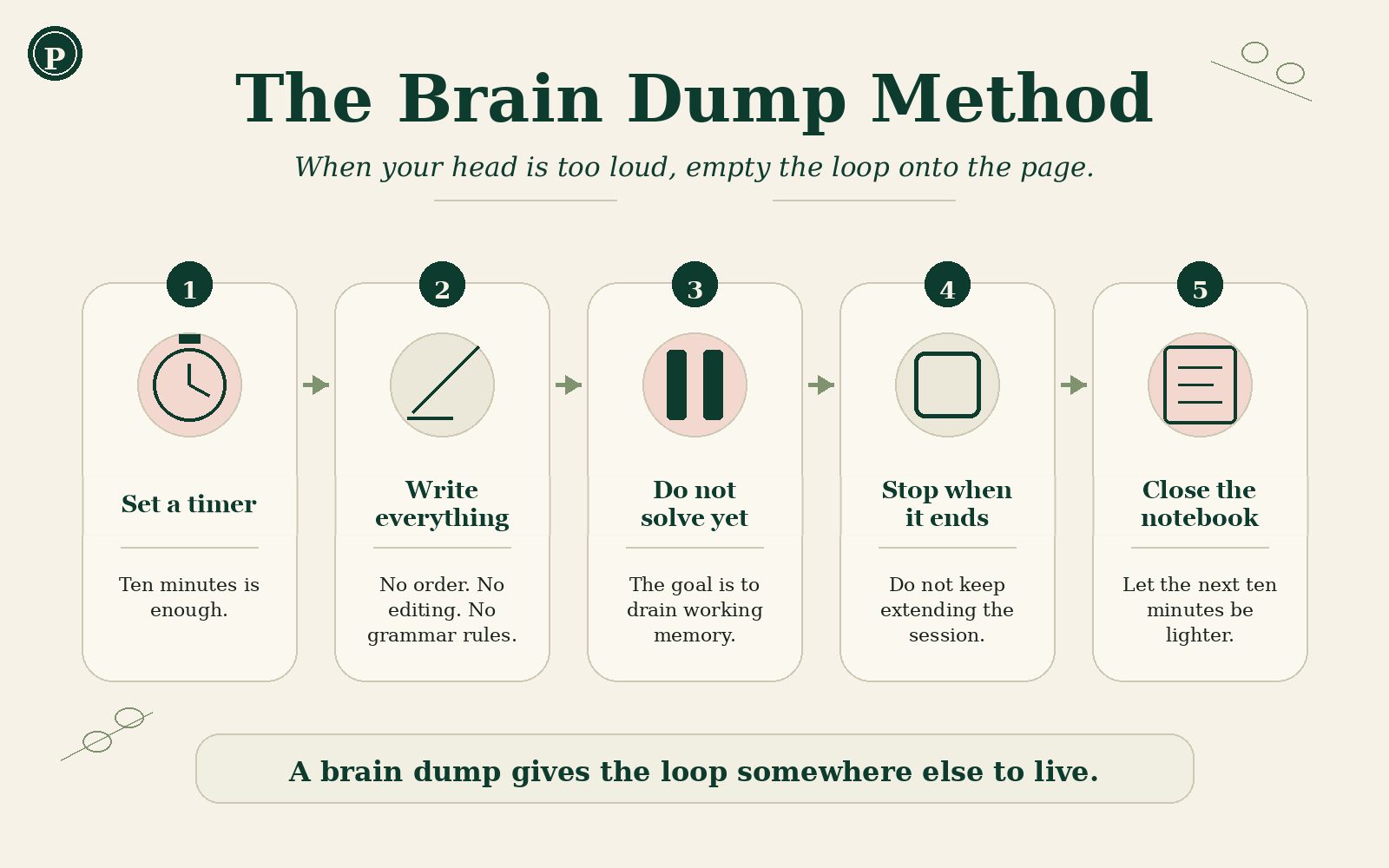
Set a timer for ten minutes. Write everything you're thinking, in any order, with no editing. Grammar doesn't matter. Spelling doesn't matter. Direction doesn't matter. The goal is to drain the working memory, not to produce a document.
When the timer ends, stop. Do not re-read. Close the notebook or the app. You will be surprised how much lighter the next ten minutes feel.
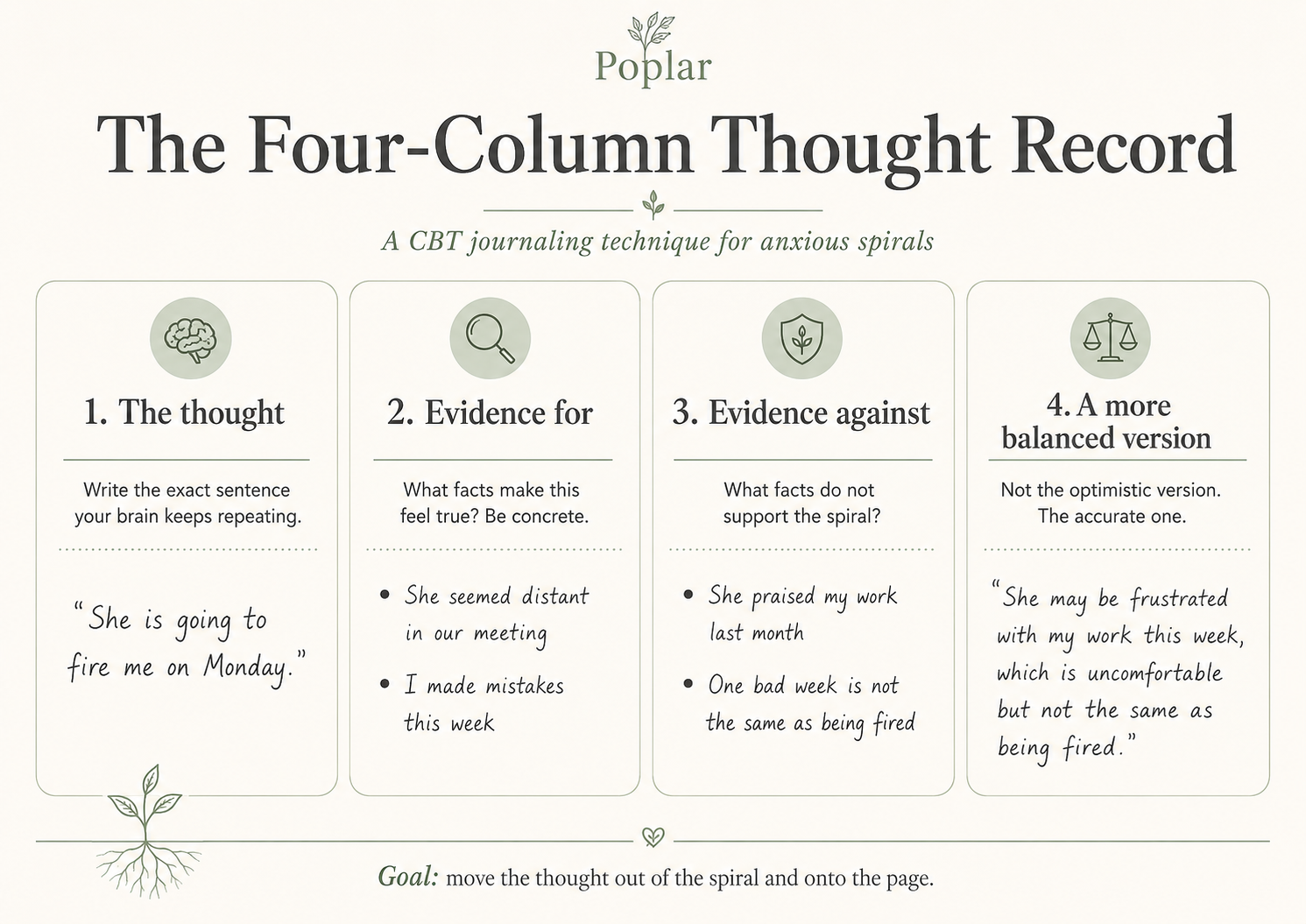
Draw four columns. Label them: the thought, evidence for, evidence against, a more balanced version. This is the move at the heart of cognitive behavioral therapy, sometimes called a thought record or thought diary.
- The thought. The exact sentence your brain is repeating. "She is going to fire me on Monday." Be literal.
- Evidence for. What makes you believe this? Three to five concrete facts. No "vibes." If "vibes" is all you have, write that down too.
- Evidence against. What contradicts the thought? Past instances where similar fears didn't come true. Things she has said or done that don't support the spiral.
- A more balanced version. Not the optimistic version. The accurate one. "She might be frustrated with my work this week, which is uncomfortable but not the same as being fired."
This is the most boring of the techniques and the most effective. It works because your brain cannot reframe a thought it has not first separated from itself.
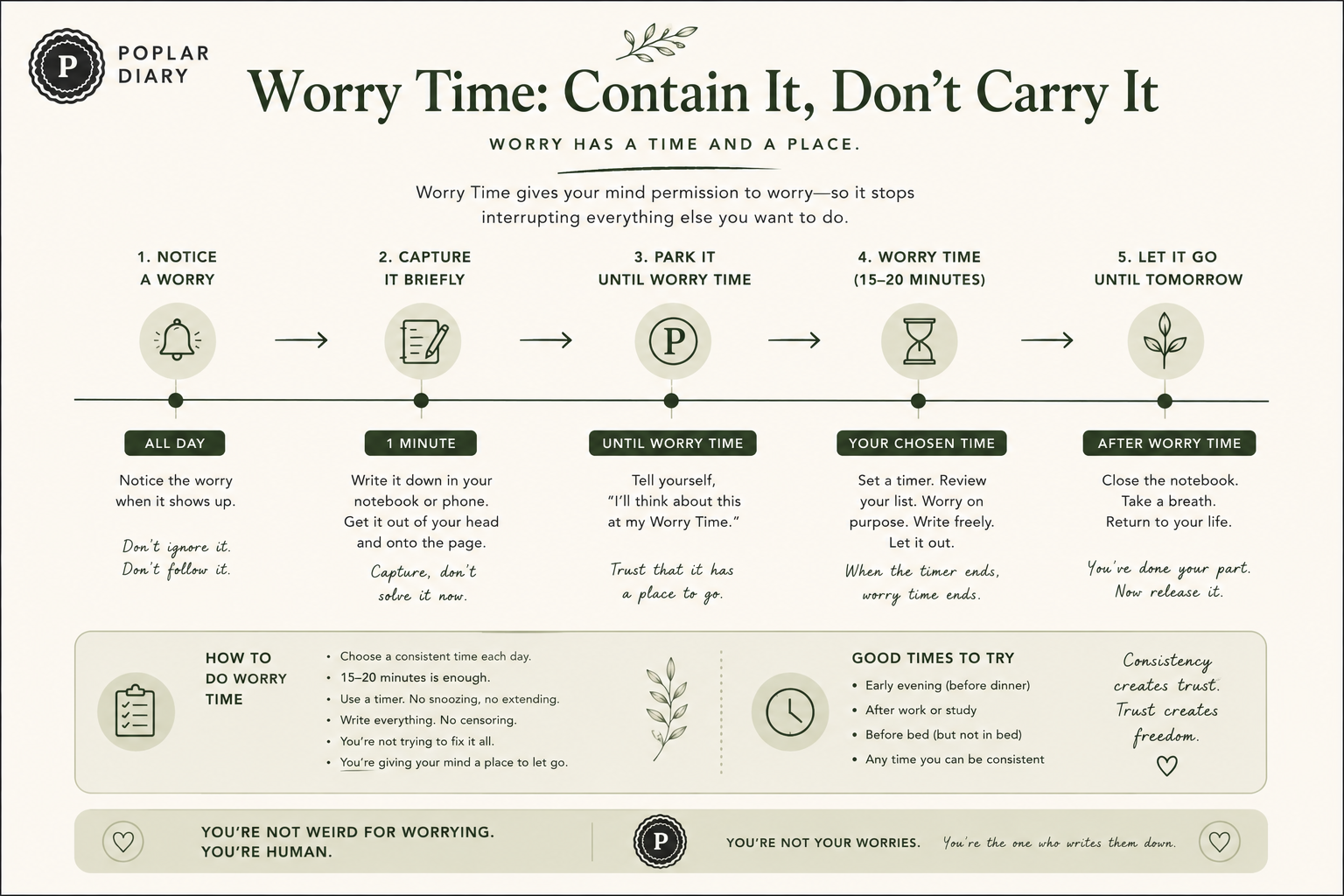
If a worry shows up at 11am, write a single line: "Worry about X." Then tell yourself you'll deal with it at a specific time, say 7pm. Set a phone reminder.
At 7pm, sit down for fifteen minutes and journal about the worry properly. Use the brain dump or the four-column, whichever fits. When the timer ends, close it.
What this does is teach your brain that worries get processed, just not on demand. After a few weeks of consistent worry time, the mid-day intrusions become less insistent because your brain trusts that there's a slot.
This is not folk advice. The approach goes back to Thomas Borkovec's stimulus-control experiments in the 1980s, and when researchers tested a thirty-minute daily worry window against letting worry come when it pleased, the scheduled version reduced worry, anxiety, and insomnia more. A small, preliminary trial, with high worriers rather than diagnosed patients, but the direction was clear.
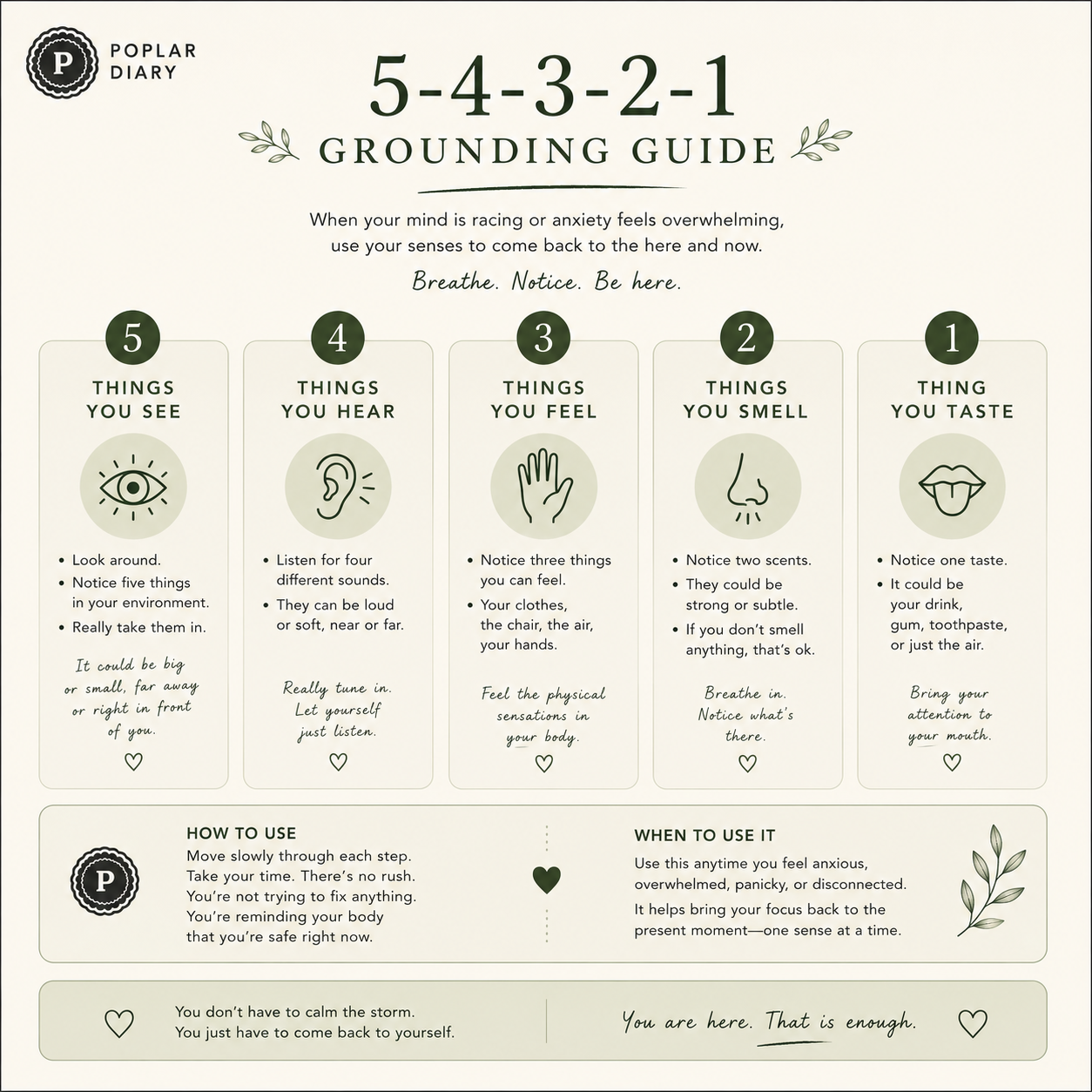
Write down five things you can see in the room. Four things you can touch. Three things you can hear. Two things you can smell. One thing you can taste.
It sounds simple to the point of silly. Try it in a moment of acute anxiety and you'll notice your shoulders drop by item three. The mechanism is real: anxiety pulls attention into the imagined future. Sensory work pulls it back to the present, which is the only place where your nervous system can recalibrate.
This is the brain dump, applied at one specific moment: the ten minutes before you turn the light off. Sit in bed or at the desk and write down everything circling in your head. Worries about tomorrow, the email you forgot to send, the conversation you keep rehearsing. Write quickly. Don't try to solve any of it.
When you're done, close the notebook and say one sentence to yourself: "These will still be here in the morning if I need them." That sentence is what tells the brain it is safe to stop guarding the thoughts. Getting the next-day items out of your head releases it from low-grade vigilance.
Pair this with the room being dark and your phone being in another room and you have given yourself the best possible chance.
Anxiety is in part an attention disorder. Your brain becomes very good at scanning for threats and very bad at noticing anything else. Gratitude journaling is the counterweight. Not the saccharine kind ("I am grateful for the sunset"), but the specific kind.
Try the 3-2-1 version. Three specific small things from today: a text from a friend, the way the coffee tasted, finishing a task you'd been avoiding. Two people who did something kind, named. One thing you did that you feel good about, even if it was small.
Three minutes, every night for two weeks, and you will notice your brain starting to scan for the good ones on its own. This is not magic. It is just repetition. Attention follows what you train it on.
The technique you'll keep coming back to beats the technique you understood best. Pick one this week. Use it on three different anxious moments. Then try a second one.
Eighteen anxiety journal prompts for the most common anxious moments.
If freewriting feels intimidating, start with a prompt. You can use the same one for weeks; it often shows you different things on different days. These are grouped by the kind of anxious moment you're in.
When you cannot sleep
- What thought is on the loudest loop right now? Write it once so it has somewhere to live besides your head.
- What is the worst-case scenario my brain is running, and what is the most boring realistic version?
- What can I genuinely do tomorrow morning about this, and what is purely waiting?
- What did I forget to feel today that's catching up with me now?
- Three things that are true in this room right now that have nothing to do with the worry.
- If I imagine setting this thought on the page and leaving it there until morning, what's the first thing I notice in my body?
When you're catastrophizing
- What's the exact scenario my brain keeps replaying, in one specific sentence?
- What is the probability I'd give it on a scale from 1 to 100, if a friend asked me to be honest?
- If it did happen, what would the first 24 hours really look like? The first week?
- What resources or people would I have access to if the worst-case did happen?
- What's a more accurate, less dramatic version of the same situation?
- What is this fear protecting me from feeling? Disappointment? Loss of control? Being seen as a failure?
When something is making you anxious and you cannot name it
- Where in my body is the anxiety living right now? Chest, stomach, shoulders, jaw?
- When did I last feel calm today, and what was happening in that moment?
- What did I check on my phone in the last hour, and what was I hoping to find or not find?
- What conversation am I rehearsing in my head?
- What did I almost cry at today, even if I didn't?
- If I could name three things I might be anxious about, and a friend asked me to rank them honestly, what would the order be?
If you want more prompts, the general journaling prompts library has dozens of others sorted by mood, and the guide to journaling for self-reflection covers the slower, less acute kind of writing that is useful between anxious episodes.
The pitfall: when journaling makes anxiety worse.
This is the most important section in the piece, and the one most guides skip.
If you journal consistently and feel worse, you may be ruminating with a pen.
Psychologists Paul Trapnell and Jennifer Campbell drew this line decades ago: rumination is self-focus driven by threat, reflection is self-focus driven by curiosity. The page cannot tell you which one you are doing. The direction of your entries over a few weeks can.
Two corrections help. First, every entry should end with a single specific next-step, no matter how small. "Tomorrow I'll ask Sarah how Monday is going before the meeting." That sentence converts reflection into action and prevents the writing from looping.
Second, if the same topic shows up in your journal for more than three weeks without movement, the journal is no longer the right tool for that topic. That is the signal to bring it to a friend, a counselor, or a therapist. The journal is excellent for noticing patterns; sometimes the pattern is "this needs more than a page."
The part you cannot say out loud.
Some of the most anxious thoughts are the ones that feel too embarrassing to share. The 3am loop about the email you sent five years ago. The thing you're afraid to admit you want. The intrusive thought your brain keeps producing that you'd never speak to anyone, including the therapist.
These thoughts also benefit from being written down, maybe more than the others. But they require a writing surface where you can be fully honest. A journal you'd be mortified to leave open. A notes app you've password-protected. Or an anonymous space where the entry isn't attached to your name.
Whatever surface you pick, the rule is the same: if the anxious thought feels too embarrassing to write where it might be read, write it where it can't be.
If that last option sounds useful, Poplar is one place to write anonymously. It's a quiet anonymous diary that pairs you with prompts and lets you write a few sentences or a few pages without anyone knowing it's you.
After you post, you see a handful of other anonymous entries from strangers who wrote on a similar kind of day. The whole structure is built for the kind of honesty that performs poorly when there's an audience.
If you've never journaled before, the guide on how to start journaling walks through the first few sessions; if you've started and stopped a dozen times, how to journal daily covers the habit side.
What to save for the next bad night.
One thing that helps with anxious nights specifically is having something to read when you cannot bear to write. Poplar has a feature called Roots. When an entry lands for you, whether it's one of your own or a stranger's, you can Root it.
Rooting saves the entry to your own Roots page, a small private collection only you can see. The author sees a count of how many people Rooted their words, but never who, and never how those words are being used. It is a very quiet kind of bookmark.
Over a few weeks of writing on a hard topic, your Roots page becomes a small library of grounding entries. Your own breakthroughs are in there. Some lines from strangers who landed on an angle your brain wouldn't have produced, while yours was looping. A reframe from someone two time zones away. A sentence that made you feel less alone at 4am last Tuesday.
What this looks like at 3am.
The 3am-anxious version of you can open Roots without writing anything first. No prompt, no blank page, no expectation. You read what already helped before, and very often that is enough to slow the loop.
There are no daily caps on reading your own Roots, the way there are on writing new posts or sending Echoes. If you want the rest of the mechanics, the guide on how Poplar works walks through the structure.
When journaling isn't enough.
Journaling can help with low- to moderate-grade anxiety, the kind that lives in the background. It is not designed for, and not sufficient for, panic attacks, anxiety that interrupts your ability to work or sleep most days, intrusive thoughts that distress you, or anxiety that's started to come with physical symptoms (chest pain, shortness of breath, inability to eat).
If anxiety is hitting that level, talk to a primary care doctor or a therapist. Cognitive behavioral therapy is the most well-evidenced talking treatment for anxiety, and medications can be a reasonable bridge while you do the work. None of this is failure. The kindest thing anyone said to me about going to therapy was: you wouldn't try to set your own broken arm.
A journal is a complement to therapy, not a replacement for it. If anxiety is severe, please talk to a clinician. The two work well together; many therapists will ask you to bring a thought record or a week of entries to a session. The journal becomes the homework.
If you're in crisis right now, please reach out to a crisis line. In the United States: dial or text 988 for the Suicide & Crisis Lifeline. The conversation is free and confidential.
Frequently asked questions.
Is journaling good for anxiety?+
Yes, with caveats. Randomized trials of positive-affect journaling and scheduled worry time found modest but real reductions in anxiety, though a clinical review of expressive writing cautions that the emotional-health findings are not as robust or as consistent as the physical-health ones.
It works best for low- to moderate-grade anxiety, alongside other forms of care. It is not a substitute for therapy or medication if your anxiety is severe.
What is the 3-3-3 rule for anxiety?+
A grounding technique: name three things you can see, three things you can hear, and move three parts of your body. It's a sensory shortcut for pulling attention out of an anxious thought spiral and back into the room. Useful in a moment of acute anxiety, especially when you can't sit down and write.
What is the 5-4-3-2-1 rule for anxiety?+
A longer grounding technique: name five things you can see, four you can touch, three you can hear, two you can smell, one you can taste. Same mechanism as 3-3-3, with more steps to give the nervous system more time to settle. Works as a journaling exercise if you write each item down rather than just noticing it.
What is the 3-2-1 method of journaling?+
Three things you learned today, two things you enjoyed, one thing you'll focus on tomorrow. A gentle end-of-day reflection that doubles as a wind-down for anxious minds. A gratitude variant of the same shape also works: three small good things, two people who were kind, one thing you did well.
How long should I journal for anxiety relief?+
Most of the research clusters around fifteen to twenty minutes per session, three to five days a week. Pennebaker's foundational study used fifteen minutes a day for four consecutive days. Shorter sessions still help, especially brain dumps. Longer sessions sometimes tip into rumination. Set a timer.
Should I journal when I'm having a panic attack?+
No. During a panic attack, your nervous system needs immediate grounding, not analysis. Use 5-4-3-2-1 or 3-3-3 in the moment, with breath work. Journal about the panic attack after, when your body is calm again, to help you understand the trigger and prepare for next time.
What is a worry journal?+
A worry journal is a notebook you use specifically to record what you are worried about, when it shows up, and what you did about it. The simplest version has three columns: the worry, the time it appeared, and whether it required action or could be set down.
Over weeks, the journal shows you which worries are recurring and which were one-time visitors, which is useful information your brain cannot hold on its own.
What is a CBT thought record?+
A CBT thought record is a structured way of writing down an anxious or distressing thought, the situation that triggered it, the evidence for and against it, any cognitive distortions you can spot in it, and a more balanced replacement thought.
It is the core journaling technique used in cognitive behavioral therapy. The four-column version in this piece is a simplified version of the same exercise.
Does gratitude journaling help with anxiety?+
It can, especially for the kind of anxiety that narrows your attention onto everything that is wrong. Specificity matters: "I am grateful that my sister called me today" works better than "I am grateful for my family." Two to three weeks of three-line entries seems to be the point where most people notice a shift in what their brain scans for first.
Can journaling replace therapy for anxiety?+
No. Journaling can ease low-grade anxiety, build the muscle of noticing your patterns, and make therapy more productive when you go. It is not a substitute for clinical care if anxiety is severe, persistent, or interfering with your ability to function. If you are unsure where you fall, a primary care visit is a reasonable place to start.
One last thing.
Pick one technique from above. Use it tonight, even badly. The brain dump is the lowest-stakes place to start. Ten minutes, no editing, no audience. Whatever's loud in your head right now goes on the page and stays there.
The version of you reading this in two weeks, with a quieter brain and a small stack of pages, will be glad you started tonight.