
A diary without likes: what removing the engagement machine actually does
Poplar has no likes, no follower count, no algorithmic feed. Here is what changes in your writing when the numbers leave the room.


Key takeaways
- The like button stopped being a kindness and became a scoreboard — it shapes what you write toward, not what you actually think.
- A public audience corrupts your voice. A quiet anonymous reader closes the feedback loop without distorting it.
- Roots, Echoes, and a mutual Friends Feed replace engagement metrics with gestures that actually mean something.
- The 3-entries-per-day cap is not a server cost decision — it's a deliberate scarcity mechanism that protects depth.
- Letting go of metrics has a real cost at first: the checking reflex fires and finds nothing. What waits on the other side is the writing you would do if nothing were counted.
What you would write if nothing were counted.
Here is a small thought experiment. Tonight, you open a blank page and start writing about the thing that has been sitting on your chest all week. You know in advance that no one will be able to count the response.
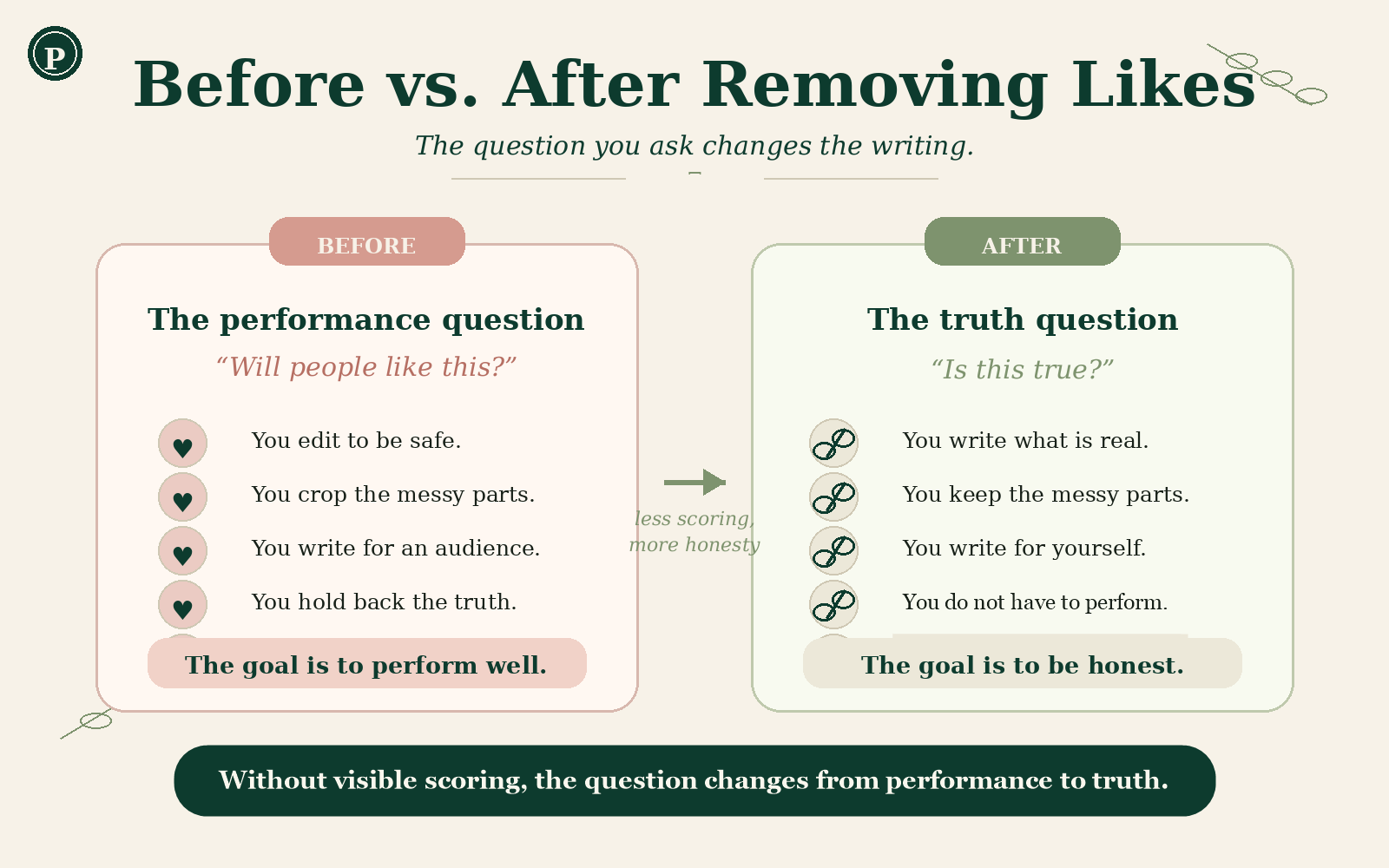
No number under what you wrote. No follower tally next to your name. No notification waiting to tell you who saw it. Now ask yourself what you would write. The answer is probably not what you would have posted on Instagram.
That gap, between the thing you would post and the thing you would say if you had a stranger across a kitchen table, is the entire reason Poplar exists. It is also the reason the diary has no like button, no follower count, and no algorithmic feed. Removing those numbers is not a brand stance. It is a working theory of what writing is for.
What the like button quietly rewards.
The like button started as a tiny act of kindness. A thumb-tap that meant "I saw this, I am with you." Over fifteen years it stopped being a kindness and became a scoreboard.
The number underneath what you posted became feedback. The feedback shaped what you posted next. And what you posted next started to look less like your life and more like a guess about what would score.
If you trace it carefully, the like button rewards a specific style. Sharper hooks. Conclusions instead of questions. Confident takes. A confessional voice that is still flattering. Anger, because anger travels. None of those are the texture of being alive. They are the texture of doing well in a quantified room.
The numbers turn on you either way.
The strange part is that the wins are not even wins. When Elaine Wallace and Isabel Buil showed Instagram users simulated posts that earned more Likes than they had hoped for, the surplus eased loneliness and still increased negative affect, an increase that grew sharper when the Like count was visible to everyone else.
The follower count does something similar in the background. Once a number sits next to your name, every post is a referendum on whether the number went up.
You write toward growth. You stop writing toward yourself.
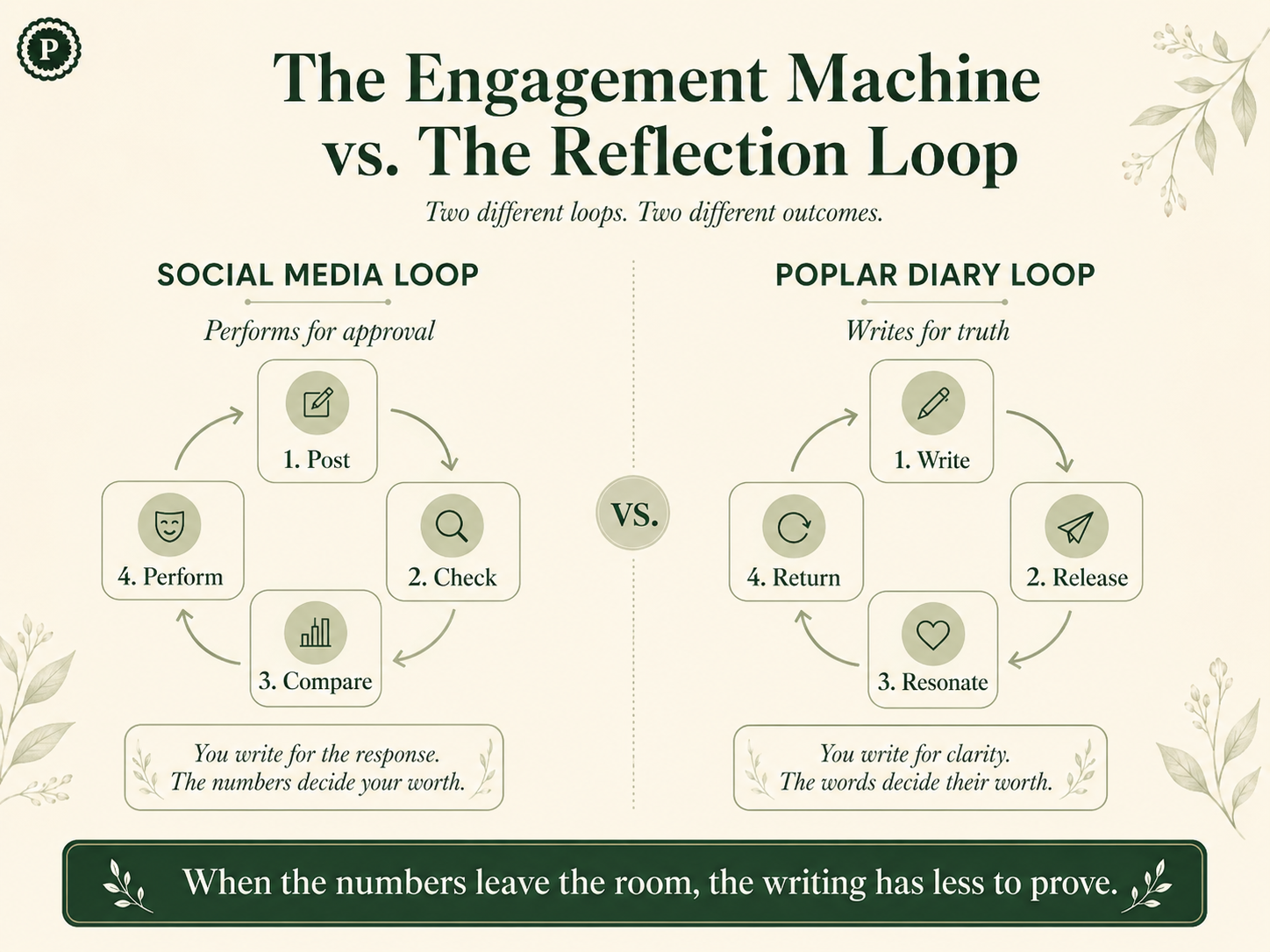
What disappears when the numbers disappear.
The first thing that disappears is the rehearsing-for-an-audience instinct. It is hard to feel at first, because most of us have been rehearsing for so long we forgot we were doing it.
You notice it is gone when, two or three entries in, you write a sentence that surprises you. A sentence you would not have written if you thought your colleagues, your ex, or a stranger on a timeline might count it.
That surprise has a long paper trail. In Adam Joinson's lab studies, people who could not be seen by the person they were talking to disclosed significantly more about themselves than people who were visually identifiable.
What goes quiet next.
The second thing that disappears is the small dopamine loop between writing and refreshing. On most diaries you finish a post, hit publish, and immediately check how it is doing. On Poplar there is nothing to check. The entry goes out. Five entries from strangers come back. The conversation is in the writing, not in the metrics.
The third thing that disappears is the worst version of comparison. When no entry has a number under it, you cannot rank anyone, including yourself. You read each entry as the human-sized thing it is.
What replaces "engagement" on Poplar.
Engagement metrics did real work. They told you something was being read. The honest version of the question is what replaces that signal when the numbers leave. Three things, in roughly this order.
A Root is a saved entry. The author can see how many of their entries are rooted, in private. No reader sees the count. It is the closest thing on Poplar to a like, and it is a private gesture from the reader to themselves: "I want to keep this." The Root is not a vote. It is somebody keeping you.
An Echo is a reply to an entry. The catch: replying requires writing a full diary entry of your own. Three Echoes per day, no more. You cannot dash off "this!" or a single emoji. If a stranger's entry moved you, the price of saying so is sitting down and writing the thing it moved in you. That price is the feature. It is the reason Echoes read like letters.
Friends on Poplar are mutual. There is no one-way following. If you and another writer add each other, you start seeing each other's entries in a separate feed. It is small by design, and it grows the way friendship grows in real life. Slowly, by reading.
None of those three are metrics. All three are gestures. That is the swap.
Why the cap of three entries a day is good for you.
Poplar caps you at three entries per day. Three Poplars sent out into the world, three Echoes back in reply. After that, the buttons stop working until tomorrow.
People sometimes read that limit as a feature for the developer's server bill. It is not. The limit is for you.
Most social products have figured out that the more you post, the less each post means, and the more dependent you become on the system to tell you whether the post mattered. The scroll-fatigue economy runs on volume. Poplar refuses to run on volume.
Three entries a day is roughly the upper bound of what an honest day produces.
If you are writing your fourth, you are probably performing. Scarcity protects depth in a way constant access never can.
The dose matters more than the apps admit. When psychologist Melissa Hunt capped university students at about thirty minutes of social media a day for three weeks, they reported significant drops in loneliness and depression compared with classmates who kept scrolling as usual. A cap, in other words, can be a kindness.
The hidden cost we don't talk about.
There is a real cost to writing into a place with no scoreboard, and it is worth naming.
You will feel a small absence at first. The muscle you trained on Instagram, the one that checks for the number, will fire. It will find nothing. For a few entries this can feel like writing into a void, which is part of what the "why I made Poplar" post is about.
Meta ran this experiment on itself. In Project Daisy, the company's internal test of hiding like counts, Harvard researchers reading the leaked files found that Instagram users placed less importance on likes, while Meta's own slides admitted no movement in overall well-being measures. Hiding the number helps. On its own, it is not a cure.
If you have been on social media for a decade, your brain has been retrained to want a specific shape of feedback. Removing that shape is not free.
You give up the small rush, and you get back the version of yourself that wrote in a notebook at sixteen, before any of it was measurable. Most people who stay decide that is a good trade. Some do not. Both reactions are reasonable.
Reading Poplar vs scrolling.
The other thing that changes, slower than the writing change, is how you read.
On a normal feed, reading is ambient. You glide. Posts blur together because they are presented as items in a stream, ranked by something other than you. You finish a session and remember almost nothing specific.
The glide has a mood cost. When Ethan Kross's team texted young adults five times a day for two weeks, the more time people had spent on Facebook between check-ins, the worse they felt at the next one, while time spent with people face to face predicted the opposite. It was small and observational, and later studies have found messier effects. The direction still stings.
Letters, not streams.
On Poplar, the entries are pulled at random from strangers. There is no ranking. How Poplar works is closer to opening a stranger's letter than to scrolling a feed.
After two weeks of reading like that, you start finishing sessions remembering specific entries. A sentence somebody wrote about their grandmother. The way somebody described a Tuesday they were dreading. Close reading replaces ambient feeding. It is the difference between consuming and being with.
A ranked feed
- Reading is ambient. You glide.
- Ranked by something other than you
- You remember almost nothing specific
Poplar
- Entries pulled at random from strangers
- No ranking
- Specific entries stay with you
When this isn't for you.
Some people need a different surface, and there is no point pretending otherwise.
There is no follower count to grow, no public profile, no way to bring readers across to a newsletter list. Substack is the tool for that, and it is good at it.
Per-entry anonymity is a default. You can put your name in the entry if you want, but no profile or signal of reach will follow you around.
The three-Echo cap, the requirement to write a full entry to reply, the absence of a comment field, all of that is deliberate.
A social diary is a different shape than a private journal app. The right comparison is not Notes vs Poplar. It is "writing alone forever" vs "writing alone but knowing someone honest is reading."
For everyone else, the cost of letting the metrics go is smaller than it looks, and the thing on the other side is closer to the journal you used to keep before the internet decided every page should have a number under it.
Frequently asked questions.
Are there really no likes on Poplar?+
Correct. There is no like button on any entry. No heart, no thumbs-up, no reaction emoji, no count under any post. The only response surfaces are Roots, which are private to the author, and Echoes, which are full-entry replies. Nobody who reads your entry can see how many other people read it.
How do I know if anyone read my entry?+
Your entry goes into the daily pool that gets pulled at random for readers. You will see Roots accumulate in private if anyone saved it, and Echoes arrive if anyone wrote a full entry in response. There is no view count. The absence of a view count is the absence of a reason to refresh.
What is the equivalent of a like on Poplar?+
The Root, and only barely. A Root is a reader saying "I want to come back to this," visible only to the author in their own count. Not a public number. Not a vote. The closer analog is somebody tearing a page out of a magazine and keeping it.
Won't I lose motivation to write without engagement metrics?+
Maybe at first. If your motivation has been the dopamine of the like count, removing it will feel like demotivation for a while. The bet Poplar makes is that the motivation can come from the writing itself, which is where it is supposed to come from.
Is Poplar an anti-social-media app?+
Sort of. It is against the parts of social media that have started to feel hostile to the people using them: the ranked feed, the public metrics, the audience-building incentive, the comparison engine. It is for the parts that mattered in the first place: reading something a stranger wrote and feeling less alone for having read it.
Do you ever plan to add likes or follower counts?+
No. If Poplar ever had a public number under an entry, it would not be the same product. The absence of those numbers is the feature. Adding them would be removing it.
How is this different from a private journal app?+
A private journal app gives you a blank page that nobody reads. Anonymous journaling on Poplar gives you the same blank page, and then five entries from strangers in return. The two practices feel similar at the page level and very different across a week.
What happens if I want to show off a piece I wrote?+
Send it to a friend. The diary will not amplify it for you. There is no share button to your followers because there are no followers. If a particular entry felt important, the right next step is to give it to one person who would care about it, by hand. That is older than social media and it still works.
One last thing.
Write the entry you would normally not post. Send it. Read the five you get back. Notice that nothing was counted. Notice that something happened anyway.