
Introducing the Social Diary: Why I made Poplar
One developer, one conviction that the internet could be smaller and warmer, and the diary mechanic that came out of it. The honest why behind Poplar.


Key takeaways
- Social media’s business model sells your attention to advertisers — when Meta tested hiding like counts, engagement and revenue dipped, and shipping the kinder feed became “a judgment call”
- Poplar was built as the opposite: anonymous, no algorithm, no ads, no follower count to perform for — just writing, people, and honesty
- In a randomized three-week experiment, students who capped social media at about thirty minutes a day reported significant reductions in loneliness and depression
- The anonymous diary inverts social media logic — the line that’s a bit too honest is the one people quietly stop on, because they’ve thought it too
- Features include Roots (bookmarks), Echoes (follow-up entries), Odyssey (collaborative storytelling), and Full Bloom — a quiet badge for three entries in one day
The internet ran out of quiet, honest places to write.
Welcome to my first blog post in this series exploring the benefits of diary keeping. In this post, I want to introduce myself and share what inspired me to create Poplar, an anonymous social diary I built because the internet had run out of quiet, honest places to write.
To be honest, it just came to me one day. I have a wild imagination and am sometimes struck with inspiration. I decided this was something I was excited enough about to make a real priority.
I’ve also felt a great sense of dissatisfaction with social media. It feels like there’s so much more space and loneliness between us all, despite seeing each other’s lives through such an invasive lens.
So much content, so little substance.
I initially found much joy in things like Facebook and Instagram, loving to share my life with others and enjoy theirs. But recently, I’ve had little inspiration to post. It’s not that I don’t lead a wonderful life; I just don’t think it’s a good idea to share our lives so openly online.
And yet I still open Facebook and Instagram several times a day, out of compulsion, to doomscroll through my hundreds of followers’ posts.
It feels like sharing images and videos of your life’s highlights is done for gratification to get as many likes and comments as possible. It’s a sanitised, edited highlight of a rich and varied life.
Life isn’t just holidays, big purchases, or new houses. There’s a whole lot of difficulty, disappointment, and drama that happens between what we show our Instagram followers.
You can share your holiday, but how many people know how much you sacrificed to get there? The long nights spent slaving away at your desk, the doctors’ visits, and the scrupulous saving.
The research on this is blunter than I expected. When psychologist Ethan Kross and his colleagues texted eighty-two young adults five times a day for two weeks, one pattern kept repeating: the more time someone had spent on Facebook since the last check-in, the worse they felt at the next one. Seeing people in person predicted the opposite.
It was a small study, and larger ones since have found smaller, messier effects. But the direction won’t surprise anyone who has looked up from a feed feeling worse than when they opened it.
We’re comparing our worst days to other people’s best ones. It was never a fair fight.
Especially not against advertising.
The machine behind the feed.
Here’s the part that doesn’t get talked about enough: the comparison you feel scrolling Instagram is a feature.
Social media platforms make their money from advertising; everyone knows that. But the more time you spend on the app, the more ads you see, the more revenue they generate. And the most reliable way to keep you on the app is to keep you feeling just slightly inadequate.
Curious enough to keep scrolling, anxious enough not to put the phone down.
This isn’t a conspiracy theory; it’s just the business model.
The product being sold is your attention. Not a subscription, not an app; your attention, packaged for brands. And the most valuable attention is distracted, emotionally activated attention.
The ads themselves are only part of it. The more insidious mechanism is the surrounding content. Influencer culture exists precisely because a person flogging a supplement or a skincare routine is more persuasive than a billboard.
The result is a feed that is simultaneously a social network, a highlight reel, a shopping catalogue, and a self-esteem regulation device, all optimised to extract maximum time and emotional investment from you, with your mental health somewhere far down the list of priorities.
Poplar doesn’t run ads. It’s obviously something quite small at the moment, and that goes without saying. But this is a crucial feature of the experience. There’s no algorithm deciding what you see based on what will keep you most agitated. No influencers, sponsored content. No feed optimised for engagement over wellbeing.
Just writing, people, and honesty.
Filling the gaps you keep hidden.
Here is Poplar’s primary intent:
To provide a safe space where you can tell people, anonymously, what it took to make a life worth sharing.
And yet many people would rather not post on social media but feel compelled to do so as they keep up with the Joneses on a massive scale.
We keep so much to ourselves. Meanwhile anxiety, depression, and burnout sit at the dinner table of nearly every family I know. You don’t need a global survey to see it; you just need to ask someone how they’re really doing.
I’m not saying Poplar is a replacement for therapy, but I certainly find it does me a lot of good to share how I’m feeling (without judgment). I’ve written separately about the benefits of journaling if you want to go deeper.
Of course, Poplar is a bit different to a private diary you’d never want anyone to read. Although you can share anything you like anonymously, it still takes courage to put your private thoughts and feelings out there. If you’ve never kept one before, this is a kind place to start.
Connecting with others, anonymously.
Posting anonymously isn’t anything new. The term "Anonymous" is synonymous with websites like 4chan, where there are no usernames, and its visitors can share almost anything they like without fear of discovery.
Psychology got there before the forums did. Across three studies in 2001, Adam Joinson compared conversations held through screens with conversations held face to face: people typing to each other disclosed significantly more about themselves, and participants who couldn’t be seen disclosed more still.
I want people to have a similar level of freedom on Poplar, just without anything hateful or needlessly offensive.
But there’s a second layer to Poplar beyond intimate expression: connecting with others.
Faceless intimacy through connected journals.
My hope for Poplar is that people will empathise, resonate, and connect with each other through their posts.
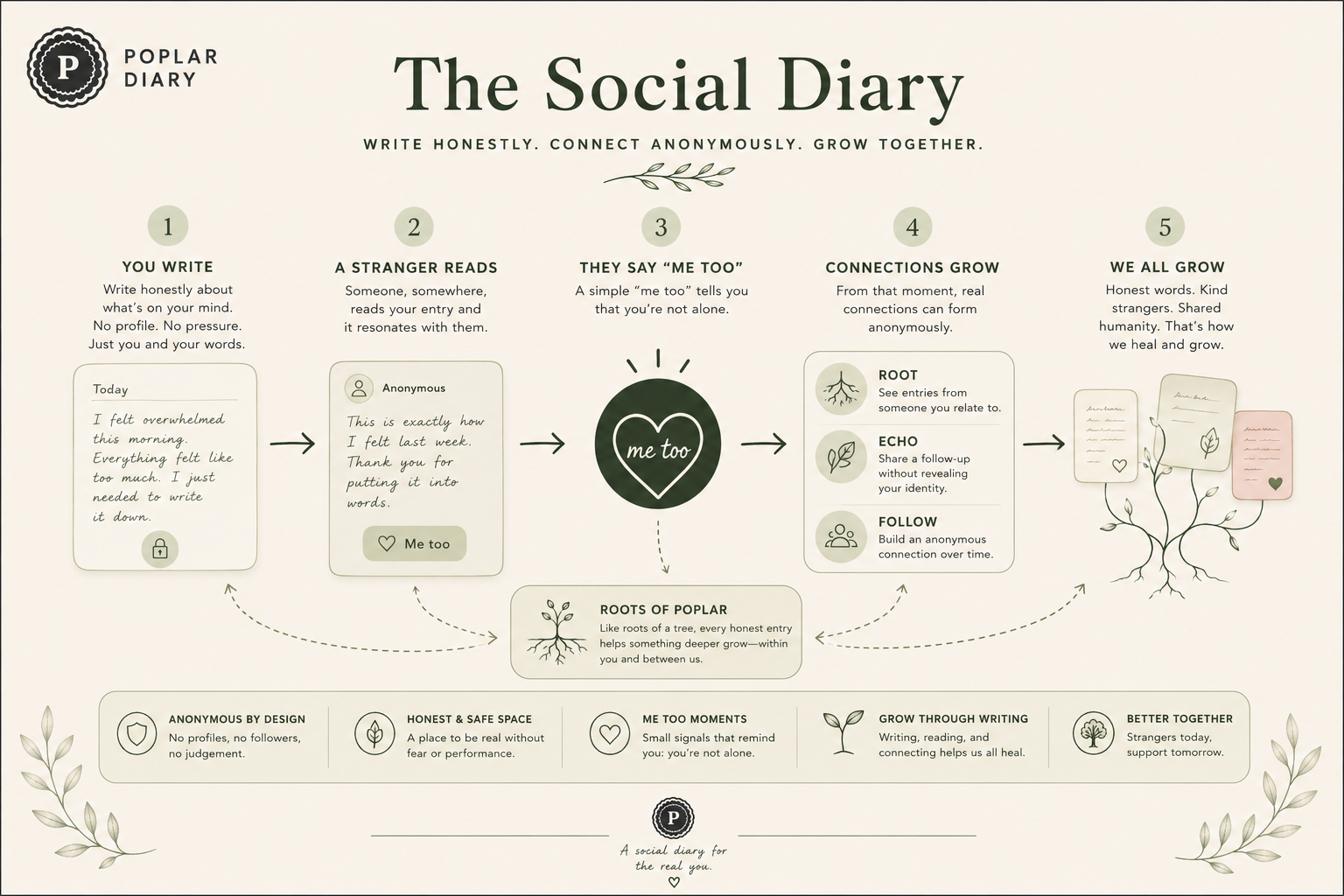
Although you can make this experience entirely your own, the real magic happens when someone reads your entry and thinks: Me too.
That’s the thing about vulnerability: it’s contagious in the best possible way. When one person is honest, it gives others permission to be honest too.
Psychologists have measured this. In 1997, Arthur Aron’s lab paired strangers and walked them through forty-five minutes of gradually deepening mutual disclosure; those pairs reported significantly greater closeness afterward than pairs who spent the same time on small talk.
And anonymity removes the social performance that makes the disclosing part so difficult in the first place. That’s Joinson’s finding from earlier: people disclose more when nobody can see them.
Follow
Follow people whose words resonate with you.
Roots
Bookmark the entries that speak to something true.
Echoes
Write a follow-up entry that builds on an initial thought or idea.
Odyssey
Write a story together, a chapter each.
You can build a little digital family out of people you’ve never met and might never meet. Sometimes it’s more than enough.
Writing together, and a small quiet badge.
Two of my favourite bits of Poplar sit slightly off to the side of the main feed. The first is Odyssey, which is collaborative storytelling. It turns out a lot of people enjoy writing something they couldn’t have written alone.
The second is Full Bloom. If you write three entries in the same calendar day, a small amber badge appears on your profile.
It isn’t a level or a score or anything to optimise for. It’s just a quiet marker that, on that day, you had a lot to put down. I like that it exists, and I like that it doesn’t do anything else.
Writing a hard day down takes some of its weight; I notice it every single time. But a private page has always been missing one thing.
Poplar just takes that one step further, adding the human element: someone out there reading your words and feeling a little less alone because of them.
How an anonymous social diary differs from social media.
When I describe Poplar to people, the first question is almost always: so it’s like a journal app, but social? Sort of. But the difference is bigger than that, and worth saying out loud.
On Instagram, you write for the people you know, and you write so you’ll be seen the way you want to be seen. The audience shapes the entry before you’ve even typed it.
You edit, you crop, you cut the line that’s a bit too honest. The post that gets the most engagement is the post that confirms a story your followers already believe about you.
On Instagram
- Written for people you know
- Edited, cropped, the honest line cut
- Engagement rewards the expected story
On Poplar
- Nobody knows who you are
- The too-honest line is the one that lands
- No follower count, no algorithm
An anonymous social diary inverts all of that. Nobody who reads your entry knows whether you’re twenty-two or fifty-one, in Cape Town or in Cleveland, doing well at work or quietly falling apart. The line that’s a bit too honest is the line that other people quietly stop on, because they’ve thought it too.
There’s no follower count to perform for, no algorithm sorting you into a niche. You’re writing to be understood rather than to be admired, which turns out to be a very different posture.
It changes what you read, too.
Instead of scrolling through people’s best Friday nights, you read someone three time zones away describing the exact shape of a Tuesday afternoon you also had. That’s the part that quietly does the work, even when you’re not writing yourself.
It’s a different kind of online presence altogether, and once you’ve tried it for a week, the rest of the feed starts to feel a bit thin.
Frequently asked questions.
Is anyone really reading what I post on an anonymous diary?+
Yes, but not in the way social media trained you to think. There’s no follower count, no notification stack telling you sixteen people liked your entry. Instead you get the occasional "root" (someone bookmarking your words) or "echo" (someone writing an entry that grew out of yours). Most entries find a handful of people who needed exactly that thing. You’re writing to be understood, not seen by everyone.
Do I have to stay anonymous, or can I put my name on an entry?+
Your call, each time. Every entry can go out anonymous or signed, and the choice is per entry rather than per account. Plenty of people keep one diary that holds both: the things they’d happily say out loud and the things they’re not ready to attach a name to yet.
Does Poplar have ads or an algorithm?+
Neither. Poplar doesn’t sell your attention, so there’s no feed engineered to keep you agitated and no sponsored content dressed up as a person. Nobody earns money from your scrolling, which means nothing in the app is designed to make you scroll for longer than you want to.
How is Poplar different from a private journal app?+
A journal app is a locked drawer, and locked drawers are good. Poplar adds the one thing a drawer can’t: the moment someone three time zones away reads your entry and thinks me too. You still write for yourself; you just have the option of being understood.
What are Roots, Echoes, and Odyssey?+
Roots are bookmarks — a way of saying an entry meant something to you without performing it. Echoes are follow-up entries that build on an earlier thought, yours or someone else’s. Odyssey is collaborative storytelling: someone opens a thread, writes a chapter of up to 300 words, and the next person picks up where they left off.
What is the Full Bloom badge?+
If you write three entries in the same calendar day, a small amber badge appears on your profile. It isn’t a streak, a level, or anything to optimise for. It’s just a quiet marker that, on that day, you had a lot to put down.
Is writing on Poplar a substitute for therapy?+
No, and it isn’t trying to be. Writing about how you feel can do real good, and I notice it every time I do. But a diary is not a clinician. Think of Poplar as a place to put feelings into words without judgment, alongside whatever support you need, not instead of it.
If everyone is anonymous, what stops Poplar from turning nasty?+
Anonymity on Poplar is for honesty, not cruelty. The rule is simple: write anything true to you, nothing hateful or needlessly offensive — and entries that cross that line don’t stay. It’s the freedom of facelessness without the parts of the anonymous internet that gave it a bad name.
One last thing.
If any of this resonates with you, Poplar is free to join. Come and plant something.