
The Digital Diary Revolution: Beyond the Paper Page
Paper journals are romantic. They're also expensive, fragile, and dead the moment they fill up. The case for digital diaries that respect attention instead of farming it.


Key takeaways
- The January notebook abandoned by February is a familiar story — digital diaries remove the friction that kills consistency, and lower barriers are what unlock deeper reflection
- Journaling translates raw feelings into language, and the expressive-writing studies behind the practice document small but real physical benefits, from fewer doctor visits to lower blood pressure
- Even in private paper diaries, people self-censor — digital anonymity changes the psychological contract and lets the honest version surface without the performance anxiety
- Digital mood tracking turns isolated reflection into longitudinal insight, surfacing patterns (Sunday anxiety, post-sleep mood dips) that paper can never automatically see
- Paper still wins on zero distractions and may win on memory encoding — the best setup is digital for the daily habit, paper for moments you want to feel slower and heavier
The notebook you abandoned by February.
There's something undeniably romantic about a crisp, leather-bound notebook. The smell of fresh pages, the satisfying weight in your hands; paper journals have a timeless aesthetic appeal. But if you've owned a few, you know how the story usually goes: the entries thin out by February. The digital diary is what happens when you stop romanticizing the ritual and start protecting the habit.
This is the new-year planner trap. Every January, millions of people invest in beautiful notebooks with the best intentions, only to watch them collect dust on a shelf. The friction is real; finding the right pen, carving out uninterrupted time, staring at that intimidating blank page. When life accelerates, paper journaling is often the first habit to fall.
Digital journaling changes that equation entirely. Rather than a chore that demands ideal conditions, a digital diary becomes a genuine sanctuary; a private, always-accessible space for personal development, reflection, and emotional processing.
The best diary isn't the most beautiful one. It's the one you're still writing in by March.
None of this is a new bet. When psychologist James Pennebaker ran the first expressive-writing experiment in 1986, students who wrote about the hardest experiences of their lives for fifteen minutes a day, four days running, made fewer trips to the student health center in the months that followed. The practice did the work; the format just has to make it happen.
The thesis here is straightforward: lower barriers unlock deeper reflection. Tools designed with guided prompts, seamless access, and distraction-free interfaces (like Poplar) remove the friction that kills consistency. The result isn't just a digital version of your paper notebook; it's something meaningfully more powerful. If you've never had a daily practice before, this is where to start.
And the science behind why that works? That's where things get fascinating.
The science of the digital sanctuary: why your brain prefers pixels.
The romantic pull of paper is real, but the case for screens is no longer just about convenience. In one field study, a team led by Ellen Isaacs gave 44 people a smartphone app called Echo, built for recording everyday moments and revisiting them later. Across more than 12,000 recordings, reflecting on past entries improved well-being on four psychological measures.
It was a small study, run by the team that built the app, so hold it loosely. But it points at the thing this post keeps circling: the screen didn't cheapen the reflection. It carried it.
Cortisol, Journaling, and Your Nervous System
Journaling is physiologically meaningful, though the popular version of the claim, that a nightly entry reliably lowers your cortisol, overshoots what the studies show. The working theory is simpler: translating raw feelings into structured language gives the brain's regulatory machinery something to grip.
What the evidence actually documents is humbler and stranger. Reviewing two decades of expressive-writing studies, Karen Baikie and Kay Wilhelm cataloged fewer stress-related doctor visits, improved immune function, and reduced blood pressure in people writing fifteen to twenty minutes at a stretch, three to five times.
The same review is honest about the fine print: the first thing most writers feel is a short-term rise in distress. You feel worse before you feel better. Mood tracking within digital apps adds the part paper can't, longitudinal data; patterns you can actually see, not just feel.
The evidence for writing it down is humbler than the hype: small, real benefits, and you usually feel worse before you feel better.
Honesty, Anonymity, and the Guided Blank Page
There's another layer worth examining: anonymity. It's easier to be honest when you aren't bracing for judgment; anyone who has told a stranger on a long flight something they couldn't say at the dinner table knows the mechanism. Digital journals, often password-protected and entirely private, reduce the social performance anxiety that can quietly sabotage honest paper journaling.
Then there's the blank page problem. Paper offers no scaffolding, and for many people, that blankness triggers avoidance. Digital apps typically offer prompts, templates, and gentle nudges that lower the barrier to entry dramatically.
Of course, the question isn't simply which format is better, it's about understanding the specific advantages each brings to your mental health toolkit. That distinction becomes much clearer when you put the two side by side.
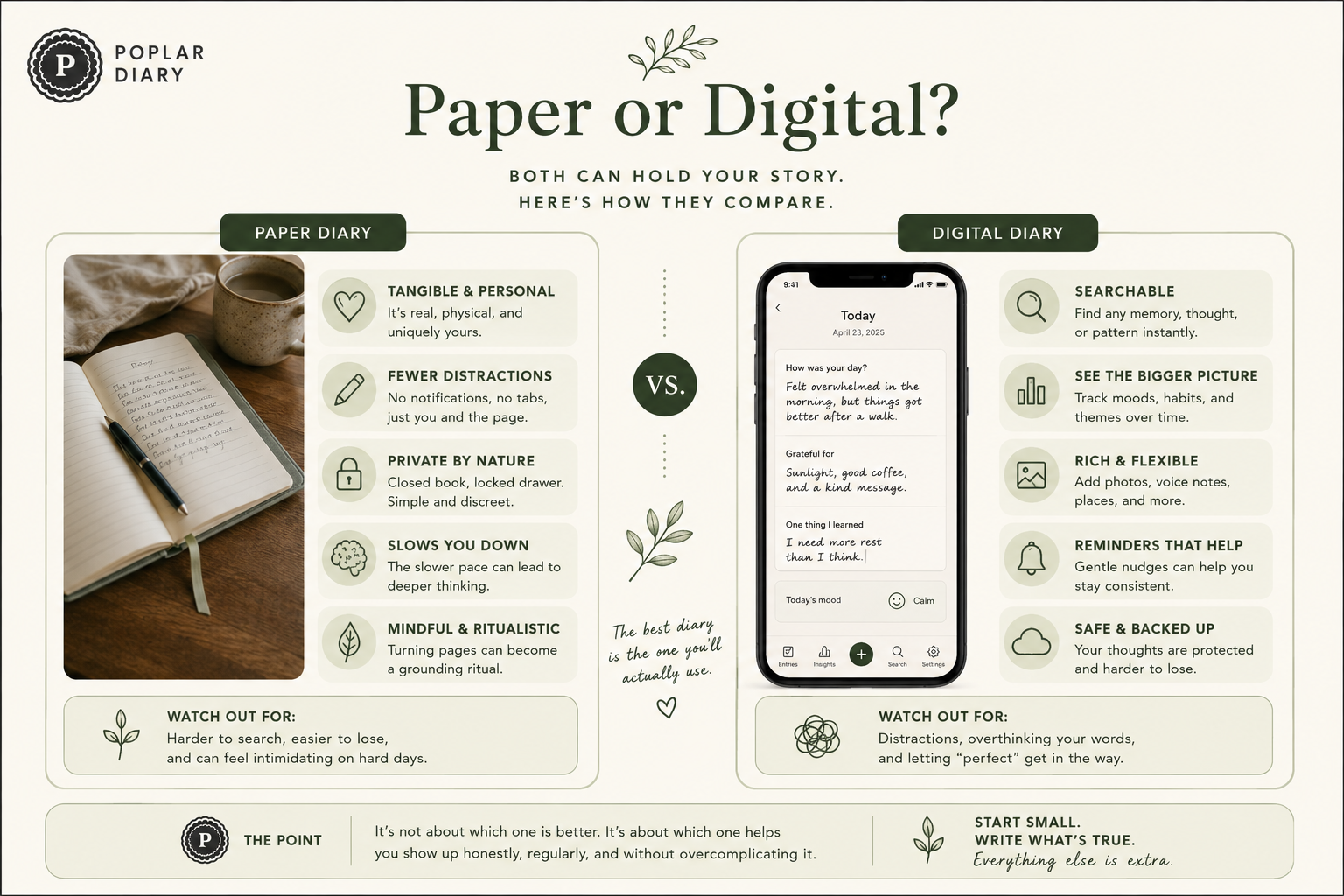
Paper vs. digital: why the new-year planner dream often fails.
Every January, millions of people invest in a beautiful new planner or journal. By March, it's buried under a pile of mail. The ritual feels aspirational, but the reality of paper journaling comes with practical limitations that no washi tape can fix, and those limitations get harder to ignore every year.
When Your Memories Are One Spilled Coffee Away From Gone
Durability is one of the most underrated advantages of going digital. A physical diary is vulnerable to fire, flooding, a leaky water bottle, or simply the chaos of a move. Years of personal reflection can vanish in an instant.
A digital journal app, by contrast, stores your entries in the cloud, automatically backed up, accessible from any device, and protected against physical damage. That entry you wrote during the hardest week of your life? It's safe, no matter what happens to your apartment.
How You Find Things Later
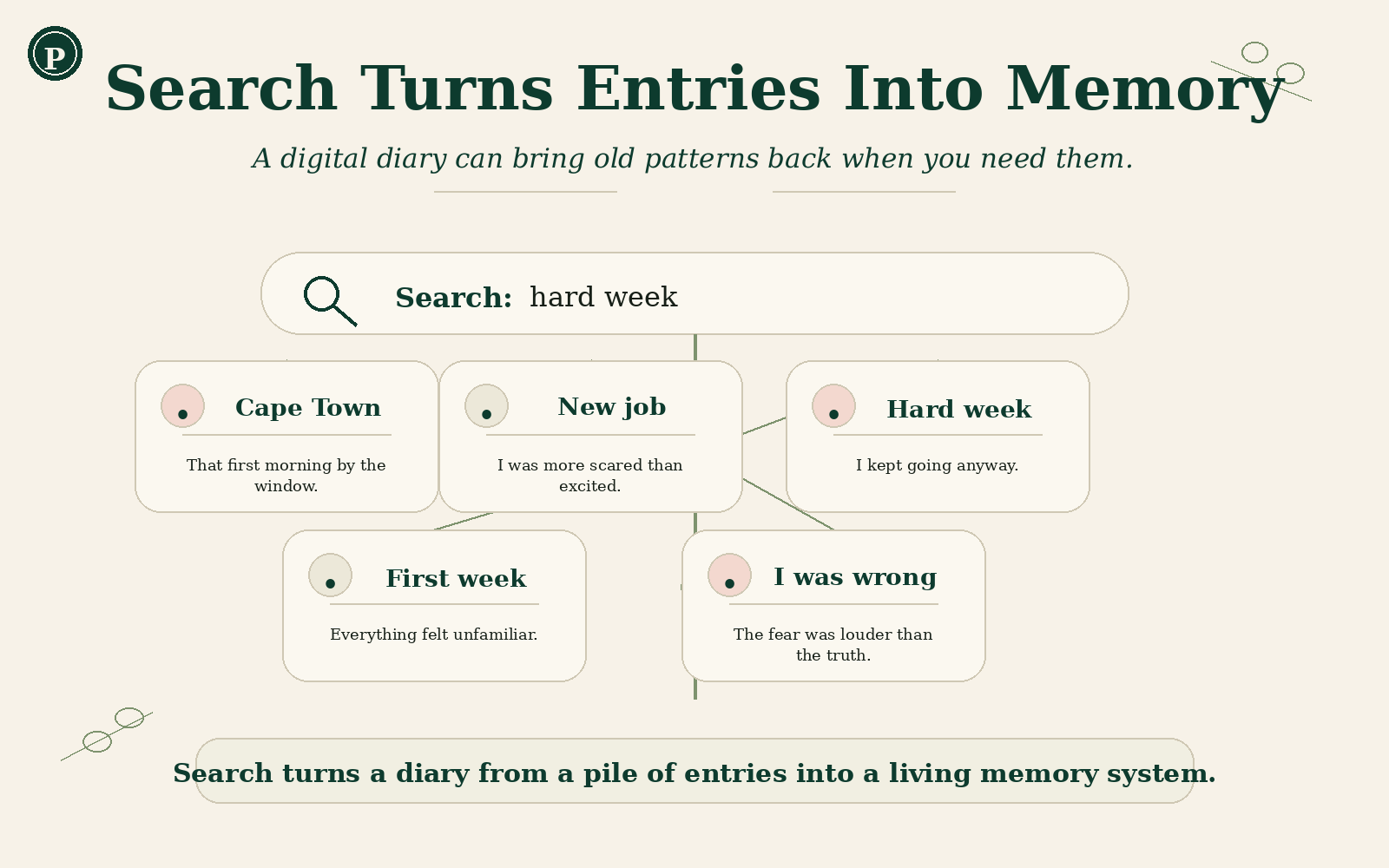
Paper diaries are linear by nature. Finding a specific thought from three years ago means flipping through hundreds of pages. Digital diaries give you better ways in.
In Poplar specifically, that means user-defined tags on every entry, a six-mood filter (Calm, Content, Fired up, Anxious, Low, Lost) that lets you pull up every Low entry from the last month at a glance, and a saved collection called Roots for entries that genuinely landed with you.
And revisiting matters more than it sounds. In a 30-day study by Artie Konrad and colleagues, 128 people wrote short reflections on their own past memories; revisiting positive ones during a negative mood reliably lifted the mood of the moment.
Momentary mood, not lasting happiness; the broader well-being scales didn't move. But the mood of the moment is exactly what a diary is up against at 11 p.m. on a bad night.
A Thousand Words Still Can't Compete With a Photo or Voice Note
Multimedia integration transforms journaling from a text exercise into a full sensory record. Attaching a photo, dropping in a voice memo, or embedding a location, these details capture context that words alone often miss. One candid photo from a vacation communicates mood, color, and energy in ways that even the most skilled prose struggles to replicate.
The Privacy Problem With Paper
Here's an uncomfortable truth: a physical notebook offers the illusion of privacy; anyone who finds it can read it. Digital journaling introduces genuine encryption and password protection, creating a lock that's exponentially harder to pick than a tiny brass diary key.
Paper diary
- One spill, fire, or move from gone
- Finding an old entry means flipping pages
- Private only until someone finds it
Digital diary
- Cloud-backed, safe on any device
- Tags, mood filters, and saved Roots
- Encrypted behind a real password
Of course, privacy in digital spaces isn't without its own considerations, and that nuance connects to something even deeper about how we express ourselves when we truly feel safe. More on that next.
The anonymity advantage: finding your voice in the cloud.
Here's something most journaling guides won't tell you: even in a completely private paper diary, people censor themselves. The fear of being found by a partner, a roommate, even a future version of yourself, quietly shapes what gets written and what gets buried.

In practice, this self-censorship turns what should be radical honesty into a polished, softened performance for an imaginary audience.
Digital anonymity changes that dynamic fundamentally. An online diary, protected by encryption and passwords that don't live in a drawer, creates a different psychological contract with the writer.
Poplar is built the opposite way. Anonymity is a per-entry toggle, not a one-time account setting, so you can sign your name to Monday's entry and post Thursday's anonymously without rebuilding anything; an anonymous entry doesn't link back to your profile from a reader's view.
There's no advertising in the diary, no data brokering, and your entries aren't fed into Poplar's AI training, or anyone else's. It's an indie product run by one developer, which means the business model has to be simple and direct, not a back-room data deal. More on how anonymous journaling works in practice.
When the risk of discovery drops, honesty gets easier. You know this from your own life: the diary page you tore out, the drafts you only finish because no one will read them. With nobody to perform for, the polished version stops being necessary, and the thoughts you'd struggle to voice in person finally make it into words.
The most honest version of your inner life rarely makes it onto paper, it's the draft you delete before anyone can see it.
However, pure isolation isn't always the answer. Some people benefit from a middle ground: private reflection with an optional social outlet, sharing anonymously with a trusted community when isolation starts feeling like avoidance rather than protection. That's the exact gap I tried to fill when I built Poplar.
That balance between raw reflection and meaningful pattern recognition raises an important question: what happens once you've found your voice, and what do you do with what it's telling you?
Mood tracking and data: turning reflection into insight.
Personal reflection is the foundation of any journaling practice, but reflection without direction can quietly backfire. Psychologists call the failure mode rumination: replaying the same negative thoughts without reaching new conclusions, so you end the session exactly where you started, only more tired.

A paper journal, by nature, offers no guardrails. You can spiral through the same painful entry for weeks without ever noticing the pattern.
This is where digital mood tracking fundamentally changes the game.
The Problem with Pure Journaling
Writing freely is valuable, but it's incomplete. Without structure, many people default to venting, which feels cathartic in the moment but doesn't build emotional intelligence over time. Digital tools solve this by layering quantitative mood data alongside written entries, creating a record that's searchable, visual, and genuinely revealing.
Patterns Paper Simply Can't See
Imagine noticing, three months in, that your anxiety spikes every Sunday evening or that your mood consistently dips after poor sleep. Paper can't surface those correlations automatically. Digital platforms can, turning isolated entries into longitudinal insight.
The 3-2-1 Journaling Framework
One practical approach is the 3-2-1 rule.
This digital-friendly structure keeps sessions brief, reduces intimidation, and prevents the kind of open-ended rumination that stalls progress.
Overcoming Writer's Block with Prompts
Staring at a blank digital page is no better than staring at a blank notebook, unless the tool fights back. Smart guided prompts ("What drained your energy today?" or "Name one thing outside your control") shift the brain from passive venting to active processing. That small structural nudge makes consistency far more achievable.
What paper still does better (and when to lean in).
An honest comparison has to admit something the rest of the internet keeps quiet: paper still wins on a few specific dimensions, and those dimensions matter.
The pen, weighed honestly.
The clearest case starts with the pen. In a famous series of studies, psychologists Pam Mueller and Daniel Oppenheimer found that students taking lecture notes on laptops tended to transcribe verbatim instead of reframing ideas in their own words, and scored worse on conceptual questions than longhand note-takers.
The honest footnote: a 2021 direct replication reproduced the verbatim-transcription gap but found no significant difference in test scores. The processing mechanism looks real; the advantage on outcomes is unsettled. If you want a moment encoded deeply, the pen may still have an edge. Hold the claim loosely.
Paper also has zero notifications. No banner from a group chat sliding into view mid-sentence. No urge to switch tabs. For some people, that absence of pull is what makes deep reflection possible at all.
And paper carries weight as an object. A leather notebook on a shelf is a memory you can hold; a cloud entry is not. For grief journals, travel journals, or letters to a future child, that physicality is part of the point.
So the honest take isn't that digital wins on every front. It's that digital wins on the fronts that decide whether the habit survives at all, and that's usually the bottleneck.
A reasonable hybrid is to keep a digital diary for daily practice and reach for paper when you want a specific moment to feel slower and heavier. Both can coexist. The question is which one carries the weekday load.
Tips for starting your digital journey today.
The benefits of digital journaling are well-documented but none of them matter if the habit never takes root. The good news? Getting started is far simpler than most people expect, and there's a full guide to building a daily practice if you want the long version.
Start Embarrassingly Small
One practical approach is to set a "low-bar" goal: just five minutes a day. Tiny, sustainable habits outperform ambitious ones that collapse under pressure. Open your app, type three sentences, and close it. That's enough.
Consistency beats depth, especially in the early weeks. A common pattern is that once the ritual feels natural, longer entries follow on their own.
Use Notifications as a Gentle Nudge
Digital tools offer something paper never could: smart reminders. Schedule a daily prompt for a time that fits your rhythm, whether that's during a morning coffee or right before bed.
Even a single notification asking "How are you feeling today?" can be the difference between a skipped day and a meaningful entry. Over time, that nudge becomes unnecessary because the habit is already wired in.
Go Beyond Text
Don't limit yourself to words. Upload a photo from your afternoon walk, record a voice-to-text entry when typing feels like too much, or attach a screenshot that captures a moment. Multimedia entries are richer and easier to create; removing friction is key to long-term consistency.
Make Your Data Work for You
Perhaps the most underrated benefit is the "Year in Review." Digital platforms can surface patterns, emotional trends, and growth milestones across months of entries. That retrospective insight, seeing how far you've traveled, is a return on investment no paper diary can offer.
Frequently asked questions.
Do I lose the brain benefits of handwriting when I switch to a digital diary?+
Partly, and the science is messier than the headlines. The famous longhand-versus-laptop studies found that pen users process ideas in their own words instead of transcribing, but a 2021 direct replication found no test-score advantage.
Either way, the benefit only counts if you actually pick up the pen, and you already know the classic fate of a paper journal: it goes quiet by February. A digital diary you use four times a week beats a paper diary you use twice a year. If you want the best of both, write big moments by hand and let the digital diary carry the daily reflection.
Are digital diaries actually private?+
A good one is. Look for end-to-end encryption, an explicit "no third-party ads" policy, and the ability to lock the app with a passcode or biometric. A paper notebook is only private until someone opens the drawer; an encrypted digital diary is private even from the company hosting it.
One last thing.
The digital diary revolution isn't about abandoning tradition. It's about upgrading your self-awareness toolkit for the life you're actually living.